

Introduction
About lamb's ears
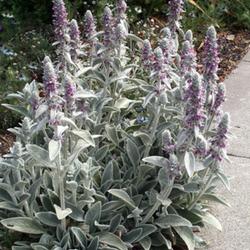
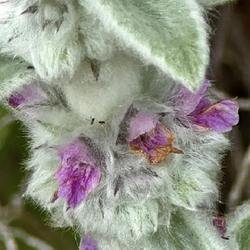
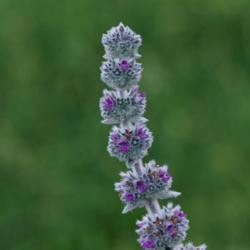
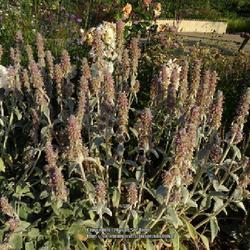
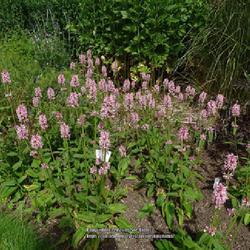
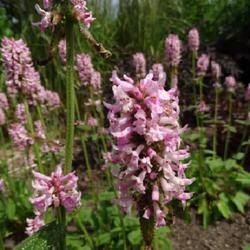
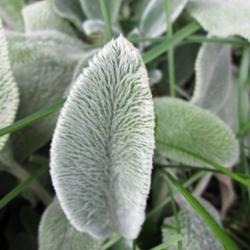
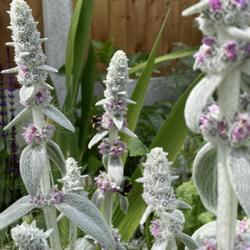
Lamb's Ears is a very hardy and strong-growing perennial, with thick white-wooly foliage, valued as a dense, low growing, spreading bedding plant in the landscape. Lamb's Ears works well when filling an area of your landscape and as a border perennial, with pink-purple flower spikes during the summer season. The foliage provides striking silvery color and unique velvety soft textural qualities.
Special features of lamb's ears
Stachys byzantina 'Helen von Stein', also known as 'Big Ears' has attractive and fragrant foliage and rarely sends up flower spikes.
Stachys byzantina 'Silver Carpet' is most known for its strikingly attractive silvery-green leaves, but rarely blooms.
Choosing a site to grow lamb's ears
The plant grows best in full sun and well-drained soil and can tolerate poor-soil conditions. Stachys byzantina is best grown in zones 4-7.
Planting Instructions
Plant in spring, spacing plants 1 to 3 feet apart, depending on the variety. Prepare the garden bed by using a garden fork or tiller to loosen the soil to a depth of 12 to 15 inches, then mix in a 2- to 4-inch layer of compost. Dig a hole twice the diameter of the pot the plant is in. Carefully remove the plant from its container and place it in the hole so the top of the root ball is level with the soil surface. Carefully fill in around the root ball and firm the soil gently. Water thoroughly.
Ongoing Care
Too much standing water captured within the leaves can result in leaf rot. Avoid this condition by dividing established dense growth. Divide plants every 3 to 4 years as new growth begins in the spring, lifting plants and dividing them into clumps. Cut back flowering stems close to ground level after they have finished blooming and they will sprout healthy new stems and leaves. An annual shearing renews the plant, removes all the dead leaves, and makes this plant grow neat and compact. Apply a thin layer of compost each spring, followed by a 2-inch layer of mulch to retain moisture and control weeds.
Frequently Asked Questions about Lamb's Ears
We keep digging this plant out and it keeps coming back, and our child reacts to it. How do we finish it off?
Two separate things are going on here, and the second one may matter more than the first. Before the eradication plan, it is worth being sure what the child is actually reacting to, because the answer changes what you have to remove.
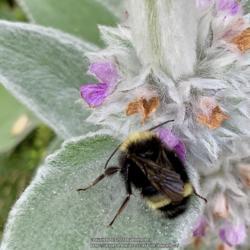
Lamb's ear is insect pollinated. Its pollen is heavy and sticky and is carried by bees rather than by the wind, so it is an unusual candidate for the sort of airborne pollen allergy that flares when something comes into bloom. That does not mean nobody reacts to it. Three other things happen at flowering time, and any of them will look like an allergy. Contact with the leaves is the first: the felted covering is made of fine hairs, and handling or brushing against them causes an itching, prickling rash in some people, at any time of year, though children are more likely to be down among the plants in summer. The bees are the second: lamb's ear in bloom is one of the most heavily worked plants in a garden, with bumblebees, honeybees and wool carder bees on the spikes all day, and a child running through a patch in flower and getting stung looks a great deal like a sudden reaction to a plant. And grasses and other wind pollinated plants peak in early summer alongside it.
Get the reaction properly identified before you plan a chemical treatment around it. A doctor can tell you whether this is an allergy, and to what. It changes the whole job: if the reaction is to the flowers, shearing the spikes off before they open removes the pollen, removes the bees and stops the plant seeding, all in one twenty minute job each year. There are also selections sold as foliage ground covers that flower very sparsely or not at all, which is what to look for if anyone in the family likes the plant but not the bloom.
Now the eradication, which is much more winnable than it feels. The reason it keeps returning is not that you missed something deep. This plant has a shallow, fibrous root system. It spreads by creeping stems that run along the surface and root down where they touch, so a patch is really a mat of dozens of small independent plants, and every rooted rosette left behind is a new colony. It also seeds freely, and the seed sits in the soil for several seasons. Digging removes the plants you can see and leaves both of those behind.
A plan that works, without any product:
- Lift, do not just pull. Water the area a day beforehand, then work a border fork under the mat and lift it in sections, turning it over so you can see the rooted crowns and pick them out. In a bed you can often roll the whole mat back like a rug.
- Bag the material, do not compost it. Rooted rosettes survive a home compost heap comfortably and go straight back onto the garden in the spring mulch.
- Then keep cutting. Whatever regrows, take it off at ground level with a hoe or a sharp spade every two to three weeks through the growing season. A leafless plant cannot restock its roots, and this is the step people abandon. It is dull, it takes ten minutes, and it is what actually finishes the job.
- Smother what you can. In a bed, a layer of plain cardboard with four inches of mulch over it, kept in place for a full season, will exhaust the survivors. Overlap the cardboard well, because a gap is all a runner needs.
- In lawn, mow it. Regular close mowing over a season weakens it badly, because the low rosettes cannot cope with constant removal and the surrounding grass then closes over the gaps.
- Plan on two seasons, not one. The seedlings that appear next spring are from the seed bank, not from roots you missed. They pull out easily when small.
On the weed killers that get recommended for this job, a few things need saying plainly. A selective broadleaf lawn herbicide of the kind sold for dandelions will kill lamb's ear growing in a lawn while leaving the grass, but it will also kill or deform any broadleaf plant it touches or drifts onto, and some of these products carry a real vapor drift risk in warm weather, which is how people damage their own tomatoes and roses from thirty feet away; they are for lawn use only, not for a border. A non-selective herbicide kills whatever it lands on, grass included, so in a lawn it leaves dead patches you then have to reseed. Read the active ingredient, not the brand name: familiar garden brand names now cover whole ranges of products with completely different chemistries under them, and the panel on the bottle in your hand is the only thing that tells you what you have bought. The label is the legal instruction, not a suggestion: it has to name the site you intend to use it on, the stated rate is a maximum rather than a starting point, there will be conditions about wind and temperature, and there will be a re-entry instruction, which normally means keeping children and pets off treated ground until it has dried. Store the container closed, in the original packaging, out of reach of children and pets, and take leftovers to a household hazardous waste collection rather than pouring them down a drain.
One more reason sprays disappoint on this particular plant: the felted leaves shed them. All those hairs hold droplets clear of the leaf surface, so a spray beads up and rolls off. Cutting the patch down and treating the young regrowth two or three weeks later works far better than spraying a mature mat.
And the point that matters most in this situation: you would be spraying the ground where a child plays, in order to solve a health problem. The physical route above will get there, and on a plant this shallow rooted it is not a bad trade. If you do decide to use a product, use it as a spot treatment on the regrowth rather than as a broadcast spray, pick a day when the child is elsewhere, and follow the re-entry instruction on the label to the letter.
Something is eating holes in the leaves and leaving debris and what look like eggs. What is it?
Before treating anything, work out whether you are looking at an insect or at a fungus, because in a hot humid summer the fungus is the more likely of the two and nothing you spray at an insect will touch it.
Start with what is on the leaf undersides, because this is the detail that decides it. Small, hard, round bodies, tan or reddish brown, all about the size of a mustard seed, sitting loose in white cottony threads at the base of the plant are not eggs. They are the resting bodies of southern blight, a soil fungus that thrives in hot humid weather and attacks the base of the plant; the white nest-like material at the crown is the fungal growth itself. They are hard between finger and thumb and roughly uniform in size and shape. Genuine egg masses are glued to the leaf in a patch or a neat row, are soft, squash wetly, and are usually paler and less regular in outline.
If it is southern blight, this is the plan. No home garden fungicide will cure an infected crown. Remove the affected plants together with the top inch or two of soil around them, bag it and put it out with the trash rather than composting it, because the resting bodies survive for years. Keep mulch and dead leaves pulled back from the crowns of the remaining plants, since the fungus feeds on that debris on its way to the plant. Improve drainage, space plants further apart for air movement, and do not replant the same spot with another susceptible plant that season.
If the damage really is chewing, identify the culprit rather than guess. Dark, gritty pellets at the base of a plant are droppings, and droppings mean caterpillars or similar chewing larvae. Slugs and snails leave slime trails and ragged holes with no droppings, and they hide in the mat during the day. Go out after dark with a flashlight, since almost everything that chews foliage feeds at night; twenty minutes at ten in the evening will usually settle the question where a daytime search finds nothing. Look under the mat and in the crown, lift a few of the lowest leaves, and photograph what you find before you clean anything up. Your county extension office is the right place to take an unidentified pest, and a clear photograph of the damage, the droppings and the insect, together with a sample in a sealed bag, gets you a much faster answer than a description does.
Treatment, once you know. For caterpillars, hand picking in the evening handles small numbers; if you want a product, a Bacillus thuringiensis preparation is the low risk option, and it comes with real limits: it only works on young caterpillars that eat treated tissue, it breaks down in sunlight so it needs reapplying, and the label must name both ornamental plants and caterpillars. For slugs and snails, traps, evening patrols and clearing the damp debris they shelter in do most of the work; if you use a bait, use an iron phosphate one, because baits based on metaldehyde are a serious poisoning hazard to dogs in particular and are best avoided outright in any garden a pet or a small child uses. And nothing preventive: do not put down a product on a guess. Everything above needs a correct identification first, and the felted leaves shed sprays anyway.
One more possibility worth raising, because it is the commonest reason clumps of this plant collapse in a hot climate. Lamb's ear is a dry climate plant. In a humid summer with warm nights and afternoon storms, the center of an established clump melts out into a brown, slimy mess whether or not anything is eating it. If that is what is happening, the fix is cultural rather than chemical: shear out the collapsed center and the flowered stems, thin the clump to open it up, water at the base rather than over the top, avoid heavy mulch against the crowns, and give it the sharpest drained, sunniest position you have. In the humid Southeast the large leaved, sparsely flowering selections hold up much better than the ordinary form, and dividing every two or three years keeps the clumps young enough to stay ahead of it.
A small reassurance while you are working on it: this plant is not toxic to people or to cats and dogs, so a pet or a child in the patch is not an emergency, and it is genuinely resistant to deer and rabbits, which is why it was planted in the first place.