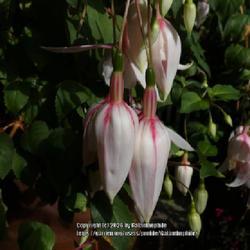
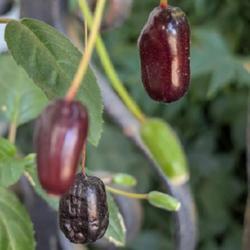
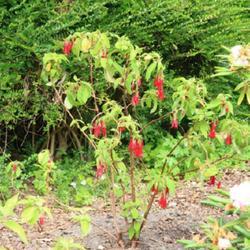
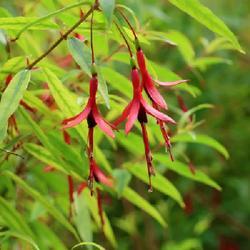
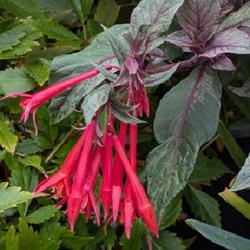
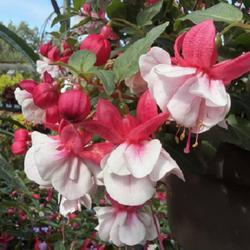
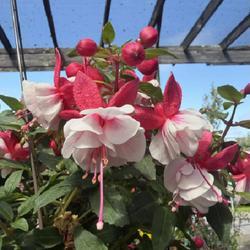
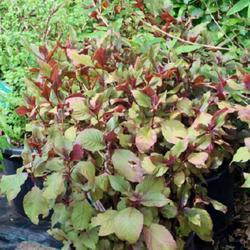
This was named poorly as an "Alba" when only the tube is sort of white. Anyway, it is a fine form. Here it flowers almost all year round unless it gets very cold or very hot, or it gets no water during a drought. The fruit is tasty too.
San Marcos Growers had this to say:
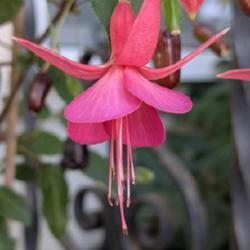
"Fuchsia boliviana 'Alba' (Bolivian Fuchsia) - A medium to large sized evergreen shrub (or even a small tree) with a spreading and open form that can reach 6 to 12+ feet tall with 3- to 6+-inch-long felty mint green ovate leaves that are lighter on the undersides. Over a long period in late summer into fall appear the 3- to 4-inch-long trumpet shaped flowers that are white to very pale pink on the outside with flared sepals and petals showing darker pink and red colors respectively on the interiors. These flowers are held hanging down in clusters (corymbs) of multiple flowers (up to 12!) at the branch tips with flowering progressing from the top of the inflorescence down. After flowering appear the 1/2- to 1-inch-long green then reddish-purple fruit that is edible and often present developing above fresh flowers below.
Plant in full to part shade in a moderately well-draining soil and irrigate regularly. Heat is this plants enemy so best in cooler coastal gardens. It is cold hardy to short duration temperature down to around 25° F in a near frost free climate. The edible fruit, while not exceptionally sweet, is nice to the taste and also is attractive to birds. This species is resistant to the Fuchsia Gall Mite (Aculops fuchsiae), a tiny eriophyid mite from Brazil that devastated many Fuchsia collections worldwide after being first discovered in the Bay Area in 1984. With its wildflowers and large foliage this plant adds a tropical feel to the garden and many think of it as the most beautiful of the Fuchsia.
Fuchsia boliviana 'Alba' is a cultivar with the white or pale pink floral tube while the straight species with red floral tubes, is the natural form native to cool cloud forests in the Andes mountains of southern Peru, Bolivia and northern Argentina. The name for the genus honors the German botanist Leonhart Fuchs (1501–1566) and the specific epithet is a reference the collection location in Bolivia by M. Roelz of the plant that the French botanist Élie Abel Carrière described as Fuchsia boliviana in 1876 in Revue Horticole. For some reason this name was considered illegitimate and modern taxonomical databases consider this name synonymous with Fuchsia sanctae-rosae, which was described by Carl Ernst Otto Kuntze twelve years later in 1898 in Revisio Generum Plantarum. For convenience's sake and because most know this plant by the name Fuchsia boliviana, we continue to list it as such."
While this species does not have the showiest flowers, in my opinion it has the most delicious fruit of all the Fuchsias I have tried. It's worth growing for the novelty fruit alone.
This name comes from Annie's Annuals, and was just a working nickname, not a registered cultivar.
It is common in the SF Bay Area, largely because it is resistant to the fuchsia gall mite.
This is a cultivar of Fuchsia arborescens, not paniculata. Fuchsia arborescens is a valid species.
See wfoplantlist.org
According to the Oregon Fuchsia Society in Portland, OR this may be hardy in zone 8 if the crown is planted deeply, to protect it during the winter.
I will be giving this a try as soon as the weather warms up enough to put this young plant out in the garden.
- » More comments