
From Seed to Seed:
Plant Science for K-8 Educators
 |
 |
 |
 |
|
From Seed to Seed: |
|
|
Digging Deeper Winter vs. Summer Why is the sun less intense in winter than in summer? And, more generally, what causes the seasons to change? As you can see from the diagram below, the earth's axis of rotation is not perpendicular to the path of its orbit. The earth is tilted about 23.5away from vertical. It takes the earth 24 hours to make one full rotation on this axis, and one full year to orbit the sun. Summer in the northern hemisphere occurs when the earth's axis of rotation is tilted toward the sun. However, since the earth's axis of rotation remains fixed throughout the orbit, when the earth reaches the opposite side of the sun six months later, the axis is tilted away from the sun. Now it's winter in the northern hemisphere.But why is the sun less intense? After all, the distance from the earth to the sun hasn't changed.* On the diagram, we've labeled 45N. This represents the approximate latitude of Burlington, Vermont; Minneapolis, Minnesota, and Seattle, Washington. In summer, the sun's rays strike that latitude almost straight on. In winter, however, the light strikes that region at a sharp angle. Because of this angle, the sunlight is "spread out" over a larger area, and is therefore less intense at any one location. (Imagine shining a flashlight at a piece of paper straight on, then tilting the paper away from the beam. When the light hits the paper straight on, the light covers a smaller area and is brighter. Tilted, it covers a larger portion of the paper, but is less intense.) Another reason the light is less intense is that it passes through more of the earth's atmosphere-again, because it is striking at an angle. 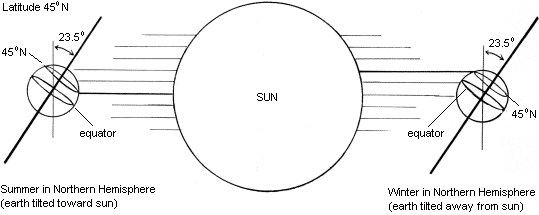 Diagram shows 45N, the approximate latitude of Burlington, VT, Minneapolis, MN, and Seattle, WA. *Technically speaking, the earth's orbit isn't a perfect circle. Rather, it is slightly elliptical, so that the distance between earth and sun varies. However, relative to the overall distance, this variation is minor and is not enough to cause dramatic changes in day length and seasons.
Please click the BACK button on your browser to return to the course. |
||
|
Made possible by a grant from Oracle Corp. Copyright 2001, National Gardening
Association, Inc. For questions regarding this web site, contact Webmaster |