From Seed to Seed:
Plant Science for K-8 Educators
 |
 |
 |
 |
|
From Seed to Seed: |
|
Although many synthetic, petroleum-based fabrics are available many people still prefer "natural" fibers. Just what characteristics are important in a fiber? In part, it depends on what purpose the fiber is going to serve. A fiber that is to be made into a rope needs to be stronger and sturdier than one that will be woven into fabric for clothing. But in general, the best fibers are relatively strong, durable, and flexible. And in many cases, the longer the individual fibers, the better. What are natural fibers made of? Most are composed primarily of cellulose. Let's look at a few. Cotton. Four species of the genus Gossypium are cultivated commercially for use in cotton production. The fibers that make up the cotton boll are categorized as surface fibers, and they originate from epidermal cells on the surface of the seed. Also called "seed hairs," the strands are made up of almost pure cellulose.
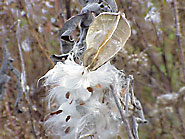
For those of you who haven't seen a live cotton plant, a more familiar example of a seed hair fiber might be milkweed. It's easy to see from a dried, burst milkweed pod that the seed hairs allow the seeds to float away on the lightest breeze, increasing their chances of landing in a place suitable for germination. Cotton is a valuable fiber because the seed hairs can be spun to make a fine, strong thread. These threads can be woven into the toughest canvas or the softest chambray. Flax, hemp, jute, ramie. These are all stem fibers, also called bast fibers, extracted from the stems of dicotyledonous plants. Stem fibers are elongated, thick-walled cells found in association with a plant's fluid-conducting phloem cells. Stem fibers commonly occur in strands or bundles. They lend strength and flexibility to a stem. Typically, stem fibers are relatively soft, but also very durable. Sisal, Manila hemp, New Zealand hemp. These are all leaf fibers that are found in the leaves of monocotyledonous plants. The cells in these fibers are thick-walled and highly lignified. Because of this, these fibers are relatively hard and stiff. Interestingly, despite the higher lignin content and rougher texture, leaf fibers tend to be less durable than stem fibers. Rayon. Rayon is made by dissolving wood pulp, then taking the solution and extruding it to form fine filaments. The filaments are hardened, then twisted into strands. Although not a natural "fiber," it does, nonetheless, contain plant-derived cellulose. Now let's move on to some other plant parts and products. |
||||
|
Made possible by a grant from Oracle Corp. Copyright 2001, National Gardening
Association, Inc. For questions regarding this web site, contact Webmaster |