From Seed to Seed:
Plant Science for K-8 Educators
 |
 |
 |
 |
|
From Seed to Seed: |
|
|
Plant poisons As is frequently the case with medications, a plant or plant derivative that is curative in small doses can be poisonous in large doses. Relatively few plants are extremely toxic when ingested in moderate amounts in their natural state. Some plant parts, however, can cause illness and even death, especially if ingested by small children. For this reason, it is important-especially if you plan to conduct Activity 41: A Natural Fix-for your students to understand that they should never concoct their own herbal remedies or ingest plant parts without proper adult supervision! Sometimes plants considered to have curative properties turn out to have a dark side. Historically, tobacco was reported to cure colds, toothache, indigestion, cancer, and more. Now the health-related problems caused by tobacco are widely known. Incidentally, tobacco derivatives are still used as broad-spectrum insecticides; nicotine is lethal to most insects as a contact poison. Here's a brief list of plants that contain toxic substances: Hemlock (Conium maculatum). We have already
mentioned this relative of dill and carrots. Hemlock juice was the poison
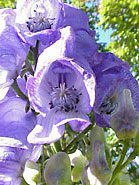
used to kill Socrates. Monkshood (Aconitum napellus). A garden perennial common in temperate regions, monkshood produces spikes of attractive blue, helmet-shaped flowers. Monkshood, also known as wolfsbane and aconite, contains the potent alkaloid aconitine, most concentrated in its roots. Aconitine is a potent, fast-acting central nervous system poison; it was used for centuries as an arrow poison. Taken in small doses aconitine can inhibit respiration; larger amounts can lead to complete heart failure. (Ingestion of just a teaspoon of the root can be fatal.)
Oleander (Nerium oleander). This attractive flowering shrub is native to the Mediterranean region and has been cultivated for centuries. Brought to North America by the early settlers, it has naturalized in warm regions of the United States. Oleander, like other members of the dogbane family, contains potent poisons. All its plant parts are poisonous if eaten, and some people develop a skin rash upon contact with the plant. Jimsonweed (Datura stramonium). Also called angel's trumpet, thorn-apple, devil's trumpet, and apple of Peru, jimsonweed is a member of the nightshade family Solanaceae, and is thus a relative of pepper, tomato, and eggplant. It is a coarse, shrubby plant with beautiful, white, trumpet-shaped flowers that open at night to attract pollinating moths. Daturas contain three powerful alkaloids-atropine, scopolamine and hyoscyamine-that produce a strong narcotic effect upon consumption. Symptoms include dilation of the pupils, giddiness, delirium, and even mania. The whole plant is poisonous, but the seeds contain the highest concentrations of the active substances. Belladonna (Atropa belladonna). This is another member of the nightshade family that contains the same three alkaloids. Italian women made eyedrops from this plant and used them to dilate their pupils, giving them the desired dark-eyed look. The name belladonna is Italian for "beautiful woman." Rhubarb (Rheum rhabarbarum). Rhubarb has both edible and toxic plant parts. The leaf petioles are the parts that are used in jams and pies. Students may be tempted by the leaves themselves-since they bear a strong resemblance to Swiss chard-however, they are mildly toxic. We've spent quite a bit of time looking at plants and the important role that they play in our lives. Believe it or not, however, we have only touched the surface on this subject-especially when it comes to plants with medicinal properties. In the next section, we will be looking at plants in a different light-one with which students may be very familiar: plants as food. We'll begin by looking at individual nutrient categories, and progress to a survey of the range of plants and plant parts used as food. |
||||
Made possible by a grant from Oracle Corp. Copyright 2001, National Gardening
Association, Inc. For questions regarding this web site, contact Webmaster |