From Seed to Seed:
Plant Science for K-8 Educators
 |
 |
 |
 |
|
From Seed to Seed: |
|
|
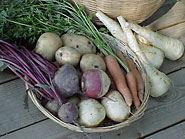
Roots. We usually categorize any plant part that has
been dug up from the soil as a root crop. Recall that not all are technically
roots-for example, potatoes are modified stems. Most root crops are richer in carbohydrates and poorer in proteins and oils than are grains or legumes. Different root crops are important sources of nutrients to people in various regions of the world. Cassava or manioc. Indigenous to eastern Brazil, the cassava
is a shrub (in the same family as the poinsettia) whose roots develop
swellings (similar to the sweet potato). Cassava constitutes an important
food source for millions of people in the tropics. It is also the source
of tapioca starch and tapioca. Sweet potato. The sweet potato, Ipomoea batatas, is in the same family as the morning glory. Although sometimes referred to as a yam, it is from a different plant family altogether. (Yams are in the genus Dioscorea; see below.) The sweet potato is well-adapted to tropical lowlands. Sweet potatoes are swollen underground storage roots, and contain more nutrients than white potatoes. Sweet potatoes contain about 70 percent water, 18 percent starch, 2 percent protein, and virtually no oil. They are unusually rich in vitamins, iron, and calcium. Yams. An important food crop in tropical West Africa, true yams are adapted to tropical rainforest habitats. There are many different kinds-some with small potato-sized roots, others with roots weighing 100 pounds. They are similar to the white potato in food value. Other nutrient-rich root crops include beet, carrot, turnip, celeriac,
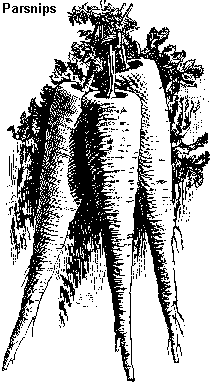
horseradish, Jerusalem artichoke, onion, parsnip, and radish. |
||||
Made possible by a grant from Oracle Corp. Copyright 2001, National Gardening
Association, Inc. For questions regarding this web site, contact Webmaster |