


Why grow berries when you could plant apples, pears, or peaches? Because while tree fruits command respect, bush and bramble berries deliver rewards with far less fuss. They rarely need spraying for pests, bear some fruit the year after planting, and reach full production by year three. Most berries need no pollinator mix, making them ideal for small spaces. Best of all, a garden of varied berries gives you a continuous harvest from June through first frost, starting with strawberries and ending with late raspberries and blueberries.
Why Small Fruits?
Compared with apples, peaches, or any tree fruit, bush and bramble berries are remarkably easy to grow and remarkably productive per square foot. A single 30-foot row of raspberries, trained against a wall or fence, yields about a quart of fruit every other day for three weeks. Plant several varieties to stagger ripening, and you'll have berries coming in waves all summer: strawberries first, then gooseberries, red and white currants, blackcap raspberries, blackberries, blueberries, and finally the late red raspberries ripening until frost.
Strawberries: The First Fruit
Strawberries are often the gateway berry, but in a diverse berry garden they play a supporting role. Rather than planting everbearing types, which stretch the season thinly, choose main-crop varieties and plant an early and a late variety to concentrate flavor and create a window of peak ripeness. Old standards such as 'Fairfax' and 'Sparkle' are prized for their softness and juiciness.
Renew the planting every year by tilling or digging under most of the plants and letting runners set in well-worked, fertile ground. Keep strawberries in a bed separate from tomatoes, peppers, eggplant, and potatoes; strawberries are susceptible to verticillium wilt carried by these crops. Use wire arches over the beds (the kind sold for plastic tunnels) to support bird netting and protect from rain splash that spreads disease.
Gooseberries: The Transition Fruit
Gooseberries grow on dense bushes that reach 2 to 4 feet tall without training. Hardy throughout most of the U.S. except the southwestern deserts and inland California valleys, they produce best in the mid-Atlantic and northeastern states.
Branches are covered with inch-long straight spines, and the foliage turns bronze to red in fall. Ripe fruits are either translucent yellow-green or dusky purple to red, depending on the variety. When fully ripe, the fruit is juicy and sweet with pleasing acidity. Crucially, gooseberries hold their quality well on the bush when ripe, so you can pick gradually over several weeks.
The earliest gooseberries fill the gap between the last strawberries and the first red raspberries. Picked when berries reach 1/2 inch and are still hard, a month from ripeness, they excel in pies and cooked desserts; this early harvest also thins the fruit so the ripe berries grow larger. Gooseberries, especially unripe fruit, are high in pectin, yielding thick jam with no added pectin. A mature plant produces 5 to 8 quarts, so one plant may be all you need.
For space-constrained gardens, train gooseberries against walls as fan-shaped espaliers or cordons. They're extremely productive and beautiful when trained this way, and picking is easier.
Gooseberries bear fruit near the base of one-year-old shoots and on short spurs on older wood, so they're forgiving of pruning. Remove about 20 percent of the oldest growth (wood that's been growing three to five seasons) each year. Cut out enough new growth to keep the plant open and easy to pick. Always save vigorous new shoots for future main branches; any new shoot cut back to 4 to 6 inches retains good fruiting potential.
Raspberries: The Summer Workhorse
Red and yellow raspberries split into two types: summerbearing and everbearing, each demanding different strategy.
For summerbearing reds, plant at least a main-crop variety and a fall type to close out the season. 'Heritage', for instance, finishes in early September in USDA Zone 6, leaving four weeks of potential ripening weather. The mistake many make is cutting raspberry canes back to make them self-supporting; resist this. The most fruitful buds are nearest the top of the canes. Instead, tie canes to two wires at 2.5 and 5 to 6 feet off the ground, depending on variety vigor. Main-crop raspberries fruit only on one-year-old canes. After harvest, cut them out at ground level to favor the new canes. When vigorous new canes are growing 6 inches apart, remove any additional ones that appear during the season. For everbearing types, fruit appears late in the first season at cane tips and again the following summer lower down on the same cane. Prune as for summerbearing, or for simplicity (and a larger fall crop), mow the entire bed to the ground after fall fruiting, sacrificing the summer harvest but reducing pest problems and eliminating trellis work.
Red raspberries spread by root suckers, leapfrogging across the garden if uncontrolled. This makes them excellent for edible fences but demands vigilance about weeding out unwanted shoots.
Black Raspberries and Blackcaps
Black raspberries ripen a little later than reds and have distinctive flavor. Unlike reds, they spread by bending cane tips to the ground where they root, not through root suckers. New shoots arise only from the original crowns. Black raspberries don't produce fall-fruiting types. The canes elongate at the tips when attempting to bend and root, becoming thin and weak unless trained. Cut them back to 3 or 4 feet to make them self-supporting without loss of fruiting potential. Remove old canes after harvest. Because they don't throw root suckers, they need far less thinning than reds.
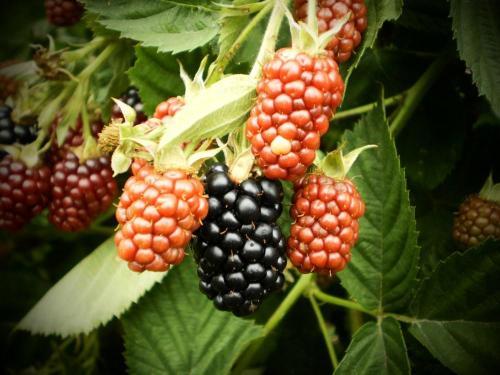
- Blackberry (Rubus 'Black Satin')
- Uploaded by FleudeLisCanna
Currants: Red, White, and Black
Though described as two different fruits by flavor alone, currants are close botanical relatives ripening at the same time and requiring nearly identical culture.
Red and white currants are among the most beautiful fruits. When ripe, plants literally drip with long clusters of gleaming scarlet beads, each berry's transparent skin glowing as sunlight shines through. They're very juicy and tart, enjoyable out of hand when fully ripe and superb for jelly, jam, and cooked desserts. Ripe currants hold on the bush far longer than most other berries without dropping.
Black currants are slightly larger bushes, producing meatier, less juicy berries that taste pungent when fresh but lose musky overtones when cooked, creating some of the finest-flavored jams. They're an acquired taste raw but well worth cultivating.
Blackberries: The Heavy Producer
Blackberry culture originated in North America, though Europe and Asia contribute fine-flavored species. Modern improved varieties blend American natives with Eurasian species. Blackberries are the heaviest-bearing bramble fruits, yielding about twice as much as red raspberries. They ripen in midsummer after raspberries finish and are more heat-tolerant than raspberries.
These are robust plants needing restraint, or they'll become weeds. They grow and train much like red raspberries, but because they throw root suckers vigorously, consider confining roots with metal or fiberglass barriers sunk 1 foot or more below ground level.
Blackberries are much thornlier than raspberries. In space-restricted gardens or for pickers with low thorn tolerance, choose thornless varieties. Many of these are limber and trailing, requiring a wire trellis. Newer primocane-fruiting blackberries (such as 'Prime Jim' and 'Prime Jan') fruit on first-year canes like everbearing raspberries, offering late-summer harvests and easier maintenance through fall mowing.
Blueberries: The Acid-Soil Specialist
Blueberries are a recently domesticated fruit; they'd likely have been cultivated much sooner if people had understood their critical need for acid soil. Brought from American wilds into gardens with limed soil, they nearly always died.
Blueberries demand soil pH between 4.0 and 5.5. Correct the pH with peat moss (mixed at least 50/50 with native soil) and perhaps soil sulfur. The bushes have extremely shallow root systems, so the heavy peat blend need not exceed 12 inches in depth. Blueberries need steady moisture; the water-retentive peat helps greatly.
One blueberry bush suffices. By its fourth season it produces a pint of fruit; at maturity (4 to 6 feet tall), the right variety yields up to 20 pints over two to three weeks. If space allows three or four varieties, stretch the harvest to 8 to 10 weeks, into fall raspberry season. Although cross-pollination isn't essential, it encourages larger fruit.
Blueberries are exceptionally handsome shrubs, noted for brilliant fall color and bright winter stems. Newer half-high varieties at 18 to 24 inches work beautifully in perennial borders. Keep bushes away from masonry walls and foundations where soil is excessively alkaline. Otherwise, they're carefree for years. Pruning is minimal: when a branch stops producing fat flower buds in fall, cut it out at ground level.
Planting Essentials
Site and Soil. Most berries thrive in full sun, though honeyberries and some currants tolerate part shade. All require well-drained soil rich in organic matter. Incorporate lots of organic matter before planting, then mulch with shredded leaves or compost every year. Mulch keeps the soil evenly moist, suppresses weeds, moderates temperature, and feeds beneficial microbes as it decomposes.
Spacing. Berry bushes and brambles are not self-sufficient loners. They need air circulation and light to dry rapidly following dew or rain, which prevents disease. Proper spacing differs by type: raspberry rows about 1 foot wide with canes 4 to 6 inches apart; blackberries and currants spaced 5 to 8 feet apart; gooseberries 6 to 10 feet apart; blueberries 4 to 6 feet apart depending on variety.
Planting. Plant bare-root stock in early spring in northern zones, bare-root or container-grown plants in early spring to fall in milder climates. Dig holes wide enough to spread roots without bending. Set the plants as deeply as they grew in their pots or with the graft union slightly above soil (if grafted). Water thoroughly to settle soil.
Pruning for Productivity
Pruning brings air and sunlight to the canes so they dry rapidly and disease doesn't establish. Left unpruned, brambles spread vigorously and tangle into an impenetrable, unproductive mass. Pruning also makes harvesting far less painful.
How Brambles Grow
All brambles have perennial root systems, but the canes (stems) are biennial. They live for two years: in the first year a cane grows vigorously, developing strong structure and storing energy. In its second year it produces fruit. After fruiting, the cane declines and dies. (Everbearing types are the exception, producing fruit late in year one and again in year two.)
Prune Out Old Canes
When summerbearing brambles finish bearing or before the patch wakes in spring, cut to the ground any canes that have completed their second growing season. Old, cracking bark and remains of fruit stalks mark these canes; they look dead because they nearly are.
Selectively Prune Excess New Canes
Brambles send up so many new canes they become overcrowded. While plants are dormant (ideally when leaf buds swell in spring), cut some to the ground. First, remove canes that have spread too far; lop them to the ground to keep the row about 1 foot wide.
Thin for Health and Access
Once narrowed, reduce the number of canes further. If plants form a continuous row, thin so plants are at least 6 inches apart. If spaced along the row at 3 to 5 feet apart, reduce each clump to 6 to 10 canes. Always spare the thickest and healthiest canes. Remove all canes with gray disease splotches or borers' swellings. Dispose of prunings well away from the patch or burn them to prevent borers from spreading to healthy canes.
Train and Head Back
Summerbearing upright blackberries, black raspberries, and purple raspberries bear fruit on branches growing from canes. Stimulate branch growth by pinching the tip of new canes when about 3 feet tall (do this several times during summer as canes reach this height). During dormancy, shorten all branches back to 4 to 18 inches, allowing sturdier branches to bear more fruit.
Trailing blackberries: cut away old canes and thin new ones. During dormancy, shorten long canes to about 7 feet and side shoots to 1 to 1.5 feet. Allow each season's new canes to trail on the ground, separate from fruiting canes, or train new canes on one wire and fruiting canes along the other.
Red and yellow raspberries: fruit stalks grow on canes themselves, not on branches. Once old canes and excess young ones are removed, shorten remaining canes during dormancy. Longer canes produce more fruit. Shorten for easier harvesting and wind prevention, typically 4 to 7 feet depending on your trellis setup. Use two wires strung between posts at 2 and 5 feet above ground.
Everbearing Brambles
Prune everbearing types like summerbearing kinds, but with one difference: year-old canes will have started fruiting at their tips late the previous year and will finish lower down in year two. Shorten those canes to just below where they stopped fruiting (old fruit stalks show the line). Alternatively, cut the whole planting to the ground after fall fruiting, sacrificing the summer crop but simplifying maintenance, eliminating pests overwintering in canes, and eliminating trellis requirements.
At Any Time
Remove dead, damaged, or diseased canes on any bramble any time of year.
Beyond the Basics: Unusual Berry Crops
Once you've established your strawberry patch and raspberry rows, explore the unusual berries that reward adventurous gardeners with flavor, ornament, and health benefits.
Elderberry
Elderberries are among the easiest and most versatile shrubs for edible landscapes. These Central European and North American natives often grow wild along roadsides and forest edges.
The prize is the fragrant, edible white flowers and delicious dark purple berries brimming with vitamins A and B, plus more vitamin C than oranges. They're high in antioxidants and have been used historically to treat respiratory ailments, colds, and flu. Use the berries in juices, jellies, jams, teas, pies, and wine. The umbrella-shaped clusters of blossoms make fritters or even champagne. If you don't harvest them, birds certainly will.
The two main types are the European elderberry (Sambucus nigra) and American elderberry (S. canadensis). The American species, hardy in USDA Zones 3 to 8, grows 10 to 12 feet tall and is the wild species found in old fields. The European type, Zones 4 to 8, reaches 20 feet and blooms earlier; some varieties have pink flowers. The red elderberry (S. racemosa) has bright red berries, but they're poisonous.
Fruit best when planting at least two varieties within 60 feet of each other. Production begins at 2 to 3 years old. Good American varieties include 'Adams' (large juicy fruits, ripening in August), 'Johns' (early-producing, prolific for jelly), 'Nova' (often self-fertile, large sweet fruits on a compact 6-foot shrub), and 'York' (largest berries, matures late August on a 6-foot shrub). European ornamental varieties include 'Black Beauty' (purple foliage, pink flowers, 6 to 8 feet) and 'Black Lace' (deeply cut dark foliage like Japanese maple, 6 to 8 feet).
Plant in full to part sun in slightly acidic soil high in organic matter, spaced 6 to 10 feet apart. Before planting, amend soil with compost. Mulch with hay, straw, or bark to suppress weeds. Fertilize annually with compost. Elderberries sucker freely and send up vigorous new branches; in late winter prune out branches older than 3 years, as they're less productive. Aim for equal numbers of one-, two-, and three-year-old branches. Yields run 12 to 15 pounds per mature shrub.

Chokeberry (Aronia)
Chokeberries, specifically Aronia melanocarpa, are natives to eastern North America that haven't gained much ground as landscape plants on this side of the Atlantic. However, in Eastern Europe they're prized for making healthful juice used for centuries.
USDA studies showed aronia juice higher in antioxidants than blueberry or pomegranate juice. It's thought to have anti-microbial properties aiding urinary tract health, colon cancer-fighting properties, and possibly helps in diabetes management. The juice sweetens remarkably when blended with blackberry and blueberry juices.
The shrub grows 3 to 5 feet tall and wide with few pests and diseases, adapting to full and part sun. White spring flowers form black berries by summer. It starts fruiting a few years after planting; mature plants yield up to 15 pounds of fruit. Fall foliage is brilliant. Excellent for edible landscapes because it's both productive and beautiful.
Other Unusual Berries Worth Growing
Several other unusual berries combine ornamental appeal with fine flavor. See our dedicated guides for details:
-
Jostaberry takes the looks of a gooseberry, removes the thorns, and makes it sweeter. It combines black currant vigor and flavor with disease resistance to white pine blister rust and mildew. The tangy-sweet flavor (grape, blueberry, and kiwi blended) works in jams, jellies, and pies, though most gardeners eat them right off the bush. Plants reach 6 feet and produce up to 12 pounds per mature bush.
-
Lingonberry is an evergreen ground cover of 12 to 18 inches, perfect for northern gardeners in Zones 3 to 8. The cranberry-like bright red berries appear in mid-summer and again in fall. Self-fertile but larger fruits result from cross-pollination. They excel in moist, acidic soils and make superb jam, the Scandinavian tradition of lingonberry sauce, and a cold remedy.
-
Honeyberry (Lonicera caerulea) produces small, elongated, blueberry-like blue fruits on 4 to 6-foot shrubs. Hardy to Zone 3 and even zone 8, these are extremely cold-hardy, have few pests, and are easy to grow. They flower early, producing fruits before strawberries ripen, and are high in antioxidants. Plant at least two varieties for cross-pollination.
Health Benefits of Berries
Raspberries, blueberries, blackberries, strawberries, and muscadine grapes appear to have cancer-fighting potential, according to research by Clemson University and the USDA-ARS Natural Products Utilization Research Unit. These berries contain a wide range of phytonutrients that can inhibit the growth of certain cancer cells in laboratory tests. In lab studies, extracts of strawberries, raspberries, and muscadine grapes reduced breast and cervical cancer cell growth rates by half. Blueberries and blackberries were less effective against cervical cancer cells but did suppress breast cancer cell growth.
Although these are lab and animal studies and work on humans hasn't been conducted yet, the results suggest it's prudent to eat a wide range of fresh, colorful berries to obtain a full spectrum of phytonutrients and support your health.
Intensive Culture
With proper attention, berries will reward you handsomely. First aim for variety and a long harvest season, then plant small numbers of each kind and care for them meticulously. Buy the smallest number of plants you can as you're learning. Incorporate lots of organic matter before planting, and mulch yearly with shredded leaves or compost. Prune regularly through the season to keep each branch or cane as productive as possible. Train bushes and brambles against walls and fences to maximize space. Each type of berry requires its own approach, but the fundamental truth holds: good culture is the foundation of a productive berry garden.
