

Introduction
Nothing says summer like freshly harvested, lightly steamed ears of sweet corn.
About zeas
Sweet corn varieties include yellow, white, and bi-colored types. Because corn is wind-pollinated, it should be planted in blocks of at least four rows rather than in long single rows. By planting early, mid, and late-season varieties you can extend the harvest over several weeks. Plant corn on the north side of the garden to prevent it from shading nearby crops.
Types of sweet corn
Modern sweet corn comes in three main types, each with distinct characteristics:
Normal sweet corn: Traditional varieties with standard sugar levels. Quality declines quickly after harvest (within one day, even refrigerated), so cook within one hour of picking for best flavor. Examples include 'Silver Queen' and 'Seneca Horizon'. Can be planted when soil temperature reaches 55 degrees F.
Sugar-enhanced (SE) corn: Developed in the 1970s, these varieties have intermediate sugar levels and a creamy, tender texture. Sugars convert to starch more slowly than normal corn, holding sweetness for up to four days when refrigerated. SE varieties have excellent cold-soil tolerance and no isolation requirements, making them ideal for home gardeners. Examples include 'Miracle', 'Sugar Buns', and 'Bodacious'. Require soil temperature of 60 to 65 degrees F for germination.
Supersweet (sh2) corn: Containing two to three times the sugar of normal varieties, these hold their sweetness for up to eight days refrigerated. They have a crisp texture but require soil temperatures of 60 to 65 degrees F or higher for reliable germination. Supersweet varieties must be isolated from other corn types to maintain quality, as cross-pollination will make kernels starchy. Separate from other corn by at least 30 feet or stagger planting times by two weeks.
Dwarf and early-season varieties
If space is limited, many modern short-season varieties thrive in small gardens and containers. Dwarf varieties (4 to 6 feet tall) resist lodging and won't shade nearby crops. Early-maturing varieties (55 to 70 days) include 'Ashworth', 'Early Sunglow', 'Earlivee', and 'Quickie'. These shorter plants are less susceptible to wind damage and can be hand-pollinated if grown in very small patches: slip a paper bag over the tassels in the morning after the temperature reaches 65 degrees F, shake out pollen, and sprinkle it over the emerging silks. Repeat for three days.
Choosing a site to grow zeas
Select a site with full sun and well-drained soil. Prepare the garden bed by using a garden fork or tiller to loosen the soil to a depth of 12 to 15 inches, then mix in a 2- to 4-inch layer of compost and/or aged manure.
Planting instructions
Plant corn directly outdoors after all danger of frost has passed and the soil temperature is about 60 degrees F. For earlier harvests, plant 4 to 6 weeks before your last frost date using treated seed and early varieties. Corn requires a good deal of nitrogen for optimum growth, so work plenty of aged manure into the soil the previous fall and plan to fertilize with additional nitrogen during the growing season if necessary. Plant corn seeds in blocks of at least four rows with 2 to 4 feet between rows, sowing the seeds 1-1/2 to 2 inches deep and 6 to 8 inches apart (space 10 to 12 inches apart for full-sized ears). Alternatively, presproute seeds in moist paper towels or start indoors in containers two weeks before planting to overcome poor germination in cool soil.
For late-season plantings, plant after July 1 and add 7 to 14 days to the listed maturity date to account for shorter, cooler days. Corn grows well in fall and can be harvested just before frost.
Ongoing care
Thin the corn to stand 12 to 16 inches apart when the plants are 4 to 5 inches tall. Provide at least 1 inch of water a week. Control weeds with frequent shallow cultivation until the plants are knee high. Then apply a 3- to 5-inch layer of mulch. Watch for signs of nitrogen deficiency (yellowing leaves) and respond with quick side-dressings of a nitrogen-rich fertilizer such as fish emulsion.
Sidedress with balanced fertilizer when corn is about 6 inches high, again when knee-high, and once more at tassel stage for best kernel development. To prevent lodging (plants falling over), hill soil up around the base of plants once they are 1 to 2 feet tall.
Contact your local County Extension office for controls of common corn pests such as corn earworms and European corn borers.
Pollination and kernel fill
Corn requires adequate pollination to develop full, well-filled ears. Wind-pollinated blocks of four or more rows typically pollinate well, but small patches and single rows may suffer from incomplete pollination, resulting in gap-toothed ears with missing kernels.
To improve pollination in small plantings, face the shortest edge of the patch toward prevailing winds. If gaps persist, hand-pollinate by gently bending the tassel over the emerging ear and shaking pollen onto the silks. Do this in the morning after dew dries, starting when pollen appears yellow on the tassel. Repeat daily for about a week as tassels continue producing fresh pollen.
Space plants generously: rows should be 3 feet apart with seeds 10 to 12 inches apart in rows. Crowded corn produces only one ear per stalk and sparse kernel set. If space is very limited, plant dwarf varieties 12 inches apart in all directions in blocks no more than four plants wide.
Baby corn
Baby corn is a harvesting technique rather than a separate variety: standard sweet corn varieties can be harvested as baby corn. Plant seeds closer than normal (2 to 4 inches apart) or harvest the lower ears on standard plantings 2 to 4 days after silks appear. To harvest both baby and full-sized corn from the same stalk, plant normally and harvest lower ears as baby corn when silks emerge, allowing the upper ear to mature fully (usually about one month later). Baby corn keeps refrigerated in the husk for about five days, freezes well, and can be pickled or added to stir-fry.
Popcorn
Popcorn is a different type of corn with denser kernels and specific drying requirements. It grows similarly to sweet corn but requires 100 or more days to mature. Plant popcorn in short blocks of four to six rows for adequate pollination, spacing seeds 6 inches apart in rows 3 feet apart. Use extra nitrogen before planting (compost, blood meal, or fish meal). Water and weed regularly, and hill soil around plants when 1 to 2 feet tall to prevent lodging.
Harvest popcorn only after husks have dried and turned tan and kernels are glossy and hard. Allow ears to continue drying on the cob in a cool, dry location with good air circulation for several weeks to months until moisture content reaches about 14 percent. When kernels shell easily from the cob, popcorn is ready to use. Store shelled kernels in airtight containers away from heat and direct sun; properly stored popcorn maintains popping quality for years.
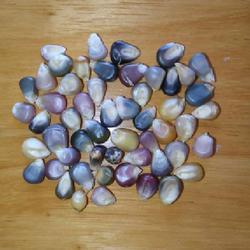
Popcorn varieties come in yellow, white, red, blue, black, and multicolored types. Yellow varieties pop into large, light-flavored kernels and expand more than white types. White varieties pop into smaller, tender, slightly sweet nuggets. Colored popcorn pops to white interiors with colored accents and nutty flavor. Short-season varieties include 'Early Pink', 'Robust', and 'White Snow Puff' (under 100 days). If growing sweet corn nearby, separate popcorn by at least 250 feet or stagger plantings by four weeks to prevent cross-pollination, which would make sweet corn starchy and tough.
How to harvest zeas
Sweet corn should be harvested when its ears are completely filled out and a pierced kernel shows a milky white liquid. Normal varieties stay in prime condition for about three days but ripen unevenly; SE and supersweet types hold quality for several days longer but ripen all together, so harvest typically lasts about one week.
Sweet corn varieties (except for supersweet varieties) lose their sweetness soon after harvest. Immediately after picking prepare the ears for eating or preserving. The silk should be dry and brown. Gently pull back the husk to check kernel development: unripe kernels have small points on their tops; mature kernels are plump and full. Refrigerate if more than one hour will pass before cooking.
Frequently Asked Questions about Corn
Is it worth soaking corn seed overnight?
Yes, and the reason is straightforward. The first thing a seed has to do before it can germinate is take up water, and corn has a tough seed coat, so a kernel left to manage that in the ground can spend several days simply absorbing enough moisture to get started. An overnight soak handles that step in advance, so the seed goes in already swollen and comes up noticeably faster. It is most worth doing with the sugary and supersweet types, whose shriveled, wrinkled kernels are slower and fussier to start than older standard varieties.
The limit matters as much as the soak. Do not go beyond twenty four hours, because water sitting around the kernel excludes oxygen, and germination needs oxygen as much as it needs moisture, so a long soak works against you and can drown the seed outright. Take the seed out of the water and plant it straight away while it is still swollen, since soaked seed will not keep and cannot go back into the packet.
Two practical points go with soaked seed. It is soft and slippery, so handle it gently and sow into soil that is already moist, because a swollen kernel put into dry ground and left there is worse off than a dry one. And do not soak treated seed, the kind sold with a colored coating, because the soak washes the treatment off and you have then handled the residue in your water.
Crows are pulling up my corn seedlings. How do I stop them?
Crows go for the seedling rather than the seed, and what they are after is the sweet kernel still attached at the bottom of the shoot. That means the vulnerable window is short, from emergence until the plants are several inches tall and the kernel is spent, so you only have to defend a few weeks.
The method that works is monofilament fishing line. String clear line about six to eight inches above each row, and run a couple of lines down either side of the plot as well. A crow coming in to land hits something it cannot see, cannot work out what happened, and leaves. Crows are genuinely intelligent birds and also cautious, and an obstacle they cannot resolve is far more effective on them than a scarecrow they can watch not move. Keep an eye on the patch anyway, because they will look for another way in and a bird that finds a gap will bring company. Check that the lines are still taut after wind and rain, add lines where you see birds working around an edge, and take the whole thing down once the plants are up and growing well.
Do not coat the seed with oil, diesel or any other petroleum product before planting. These are sometimes passed around as old tricks, but they belong nowhere near a food garden or garden soil, they harm the soil life you depend on, and they can prevent the seed from germinating at all. Mothballs in the furrow are worse. Mothballs are a registered pesticide whose label permits only enclosed indoor use against clothes moths, so putting them in garden soil is both illegal and a real hazard to children, pets and groundwater, and the fumes can inhibit the seedlings you are trying to protect.
Squirrels strip the ears just before they ripen.
Squirrels time it perfectly, which is what makes it so galling: they take the crop in the last few days before you would have picked it. Where you cannot fence the garden, the practical approach is a physical barrier at the ear rather than around the plot. Slip a paper bag or a mesh sleeve over each developing ear once pollination is finished and the silks have browned, and secure it around the shank. That also foils birds and keeps raccoons guessing. It sounds fussy, and on the twenty or thirty ears a home garden carries it takes one evening.
Commercial repellents, including the predator scent products sold for the purpose, do have some effect. Use only a product with a current label that covers food crops and the animal you are dealing with, apply it at the stated rate, and observe the preharvest interval on the label. Something registered for ornamental beds is not cleared for use on sweet corn.
Do not use a homemade cayenne, oil or soap spray on the husks. Home recipes carry no label, no rate and no tested preharvest interval, capsaicin is a serious eye and airway irritant when it is sprayed, and the mixture goes straight onto something you intend to eat. If squirrel pressure is heavy every year, hardware cloth cages over the block and picking promptly at the milk stage will do more than any spray.
Ants are swarming the ears and something is boring into the stalks.
Ants on sweet corn are usually a symptom, so read the situation before you treat it.
Look for aphids first. Ants farm aphids for the honeydew they secrete, and aphid colonies cluster on the undersides of leaves and in the leaf axils and tassels. If aphids are what brought the ants, get rid of the aphids and the ants lose interest and go. A strong jet of water knocks them off, repeated every few days, and an insecticidal soap works if the population is heavy. Any soap product you use must carry a current label listing sweet corn, and you must follow its rate and its preharvest interval, because this is a food crop.
Then divert the ants that remain. Ants want sugar, so once you see them on the corn, set out something sweeter than your ears, plain sugar or sugar water, close enough for them to find but away from the patch. Timing is the whole trick: do not put bait out before you see ants, or you will have invited them to the corn yourself.
Finally, check what is actually boring the stalks, because holes drilled into stalks are not typical ant behavior and ants exploit an opening more often than they make one. European corn borer and common stalk borer both tunnel into corn stalks, and an entry hole with sawdust-like frass around it is their signature. That is a different problem with a different answer, and it is worth having identified by your county extension service before you plan next season, because the timing of any control depends on which insect it is.
If your ears are nearly ready, holding off on spraying anything is the right instinct, and it is exactly why the preharvest interval exists.
There are earwigs in the tops of the stalks. Do they matter?
They are not harmless bystanders. Earwigs feed on silks and tassels, and silk damage means poor pollination and gappy ears, so it is worth pushing them out even when you cannot see chewing on the ears themselves. The husks give them exactly what they like, which is somewhere dark and damp to spend the day.
Trapping works well and needs nothing you would not use in an organic garden. Sink a shallow can, a cat food or tuna tin, in the soil around the plants and put an inch of vegetable oil in it, and earwigs are drawn in and drown; empty and refill the traps as they fill up, and place them where children and pets cannot get at them. Or dampen sheets of newspaper, roll them loosely and lay them on the soil just before dark, then shake each roll out into a bucket of soapy water in the morning. Start early in the season at soil level, before they climb the stalks and get into the ears, because trapping a small population in June is easy and trapping a large one in August is not.
Sanitation does the rest, since earwigs breed and shelter in weeds, dense debris and boards left lying about, so clearing that out of the corn patch removes most of the habitat. A little earwig activity is tolerable, and they do eat aphids and other soft bodied insects, so the goal is keeping them off the silks rather than eliminating them.
My corn is tasseling at only two or three feet tall. Will it grow any taller?
No. When the tassel emerges, vegetative growth is finished and the plant has switched to reproduction, so a plant tasseling at two to three feet is essentially at its final height for the season. It may add a little stem length, but meaningful growth has stopped.
Whether that height is normal depends partly on what you planted, because a given variety name can be attached to ornamental corn, to popcorn and to sweet corn lines, and those differ a great deal in mature height. Check what the packet or catalog says the variety should reach, since some genuinely short ornamental and popcorn varieties do tassel naturally at lower heights. But early tasseling on an undersized plant usually points to stress rather than to variety.
A corn plant trying to reproduce before reaching full size is rushing to set seed before conditions get worse. The three usual causes are cold soil at planting, inadequate nitrogen for the season, and insufficient water. Corn germinates best in soil at least 60 degrees, so seed planted early into cold, wet ground gets a slow start and the plant stays smaller and more stressed. Corn is also a heavy feeder that needs ample nitrogen to reach normal height, and feeding at tassel stage is too late, because the damage is already done; that one is a soil preparation issue for next season. And corn needs thorough, regular water all season, so drought stress early on stunts the plant and pushes it into early reproduction.
What does early tasseling mean for my crop?
The consequence that reaches your dinner plate is poor kernel set, and it is worth knowing about now rather than at harvest. Corn is wind pollinated: the tassel sheds pollen, that pollen has to land on the silks below, and every single silk leads to one potential kernel, so a gap anywhere in that chain shows up as a bare patch on the cob.
Stress works against this in two ways. A stressed plant sheds less pollen and sheds it over a shorter period, and stress also pushes the tassel and the silks further out of step with each other, when corn already tends to shed pollen slightly before its own silks are ready. When shedding finishes before the silks emerge, there is nothing left in the air to pollinate them. Expect ears with scattered or missing kernels rather than fully filled ones; they will still be edible and worth harvesting, just gappy.
There is one thing worth doing while the tassels are still shedding. Watch for silks emerging, and if they appear while pollen is still being shed, hand pollinate by cutting or bending a tassel that is dropping pollen and tapping or brushing it over the silks of the other plants. Doing that every couple of days over the shedding period noticeably improves fill on a small stand.
How do I prevent stunted, early-tasseling corn next season?
Wait for warmer conditions before planting if cold soil was the problem, and get the soil to at least 60 degrees before the seed goes in. If nitrogen was inadequate, work the soil deeply with compost or aged manure before planting, or sow a winter cover crop such as crimson clover or hairy vetch in fall and turn it under a few weeks before spring planting so it has time to break down. For water, monitor the soil regularly through the season and soak it deeply and regularly so the full root zone is wet, rather than relying on light sprinkling.
And plant in a block of at least three or four short rows rather than one long row, whatever else you do. Pollen falling from any plant then has other plants' silks beneath it whichever way the wind is blowing, while a single row lets most of the pollen blow off into open ground. Missing kernels on the cob are far more often a pollination problem than a pest problem, and this is one of the most common reasons home-garden ears come out half filled.
Is there anything I should know before applying anything to sweet corn?
Yes, because this is a food crop. Anything you apply, whether it is an insecticide, a soap or an animal repellent, must carry a current label that names sweet corn and the pest, and you must follow that label on rate, protective equipment, reentry and preharvest interval. Do not eat or give away corn from a treated block before the stated interval has passed. Homemade sprays, petroleum products and mothballs have no place in the garden. Store every product out of reach of children and pets, and keep both away from treated ground for the period the label requires.
Why does corn have to be planted in blocks?
Because every kernel is its own pollination event. Wind carries pollen from the tassels at the top down onto the silks, and each silk that misses its pollen leaves an empty space on the ear. A single long row wastes most of that wind-blown pollen; a block of shorter rows standing together gives every silk a fighting chance. Variety separation matters in the same season, not just for saved seed: field corn pollen landing on sweet corn silks makes those kernels starchy and tough, and supersweet (sh2) types must be isolated from standard (su), sugar-enhanced (se), and field corn by at least 100 feet or by staggered planting dates so tassel bloom does not overlap.
Why are my ears only half filled with kernels?
Either the silks never got pollen, or something ate the kernels. Chewed-off silks (earwigs, beetles) and wide spacing or wet weather during pollen shed both leave gaps and blank tips; plant in blocks next year, and consider cutting a tassel and shaking it over the silks to hand-fill the gaps. Corn earworms are the other culprit, tunneling into the ear tip and destroying kernels: apply mineral oil to the silk tip only after the silk has wilted and browned, when pollination is already complete, since oil applied earlier blocks the pollen itself.
Which sweet corn varieties handle a hot climate?
Supersweet hybrids bred for warm regions beat the traditional varieties where heat stress cuts yield; sugar-enhanced supersweet types were developed for exactly that use. Old open-pollinated standards like Silver Queen and Golden Jubilee mature slowly in heat. Weather still swings results year to year, so one poor season is not a verdict on your garden.
Is ornamental corn edible?
It is the same species as sweet corn and not toxic, but it is flint corn: hard and starchy by design, grown for decoration or grinding into meal rather than eating off the cob. Varieties bred as flour corn are the ones to try for eating colored corn, harvested at the same milk stage as sweet corn, and even they are tough next to a sugar-rich variety.
What is the white foam on my corn stalks?
Either smut, a fungal infection, or the plant sealing an injury from boring insects or beetles. Wash the foam off and inspect for damage or the insect itself. Once the damage is done there is little to reverse; remove heavily damaged stalks so fungal spores or pests do not move to the neighbors, and expect the stalk to lean or fall in the following weeks.
Is the "corn plant" houseplant related to corn?
No. The houseplant sold as Corn Plant is Dracaena fragrans, a tropical foliage plant with no connection to maize, and it is toxic to cats and dogs, so keep it out of a pet's reach. If yours flowers indoors, take it as a compliment: bloom in captivity means the growing conditions are unusually good.