


Gardeners have long believed that a healthy garden requires a healthy soil. This is true. Healthy soil produces healthy, resistant plants. But pests don't check the soil quality before deciding to visit your garden. When insects and disease do strike, it doesn't mean the end of your harvest. It simply means that something isn't in balance. The key is knowing what's causing the problem and how to fix it with the least risk to your garden, family, and environment.
Integrated pest management (IPM) is a practical approach that emphasizes prevention and cultural practices first, then adds physical controls and beneficial insects, and uses the gentlest chemical sprays only as a last resort. This philosophy has transformed how gardeners think about pest control over the past several decades.
Step 1: Identify the Pest
Insect Control Rule Number 1: Never spray an insecticide until you have identified the culprit. Not all insects are pests. Many are beneficial, and most are simply benign. Ants on peony buds are harmless. A small number of holes in broccoli leaves usually is not a concern. A completely skeletonized plant is. Understanding what you are dealing with is the first critical step.
Tools for Diagnosis
To identify your pest, you will need basic tools: a notebook, magnifying glass, camera, and a jar for collecting samples. Examine the plant closely. Check the leaves on both the top and bottom, looking for insects, caterpillars, and egg masses. As you touch the leaves, watch for scurrying or flying insects. Jot down notes, take a photo, or collect a sample so you can research the possible culprits using a field guide or gardening reference.
Wait to spray until you have made a positive identification. Many insecticides kill not only pests but also beneficial insects, including predatory insects that eat the pests and pollinators like honeybees.
Types of Feeding Damage

Tomato hornworm feasting on a tomato leaf.
Entomologists (insect specialists) categorize insects by how they feed:
Chewing insects eat leaves, creating holes, ragged edges, and "skeletonizing" (eating the tissue between leaf veins). Examples include weevils, caterpillars, flea beetles, and Japanese beetles. Look for telltale frass (excrement) of the larger pests.
Sucking insects pierce a hole in plant tissue and suck out the fluids. Signs include stippling on foliage, silvery or bronze leaves, and discolored blooms. Examples include spider mites, aphids, thrips, and leafhoppers. These pests often leave behind moltings, the outer skin they shed as they grow.
Root feeders and stem feeders, such as wireworms and cutworms, work below or at ground level.
Consider Non-Pest Causes
If a plant is struggling, consider non-pest causes first. A wilted plant may indicate a soil moisture problem. Symptoms of nutritional deficiencies (yellowing leaves, stunting, weak growth, poor production) are often mistaken for pest damage. If you see symptoms like these, consider testing your soil nutrients and pH levels.
Step 2: Prevention and Cultural Practices
The best defense against garden pest damage is a long-term program of soil building and good gardening practices. These techniques cost little or nothing and should be your first line of defense.
Grow Resistant Varieties
Select the right varieties for your climate and planting site. A disease-resistant apple tree such as 'Liberty' will require much less spraying than susceptible varieties. A blight-resistant cucumber variety such as 'County Fair' will make controlling this disease much easier. For potatoes, the variety 'King Harry' is resistant to Colorado potato beetles. When you shop for seeds and plants, look for disease or pest resistance noted in the catalog or plant label.
Rotate Crops
Rotate crops by not planting the same family of vegetables in the same location for at least three years. This breaks the cycle of pests and diseases that overwinter in the soil. For example, rotate potatoes and tomatoes, or brassicas (broccoli, cabbage, kale) to different beds. This practice is one of the most effective long-term pest prevention strategies.
Build Healthy Soil
Healthy soil produces healthy, pest-resistant plants. Insects can sense when a plant is struggling and, like animals in the wild, are more likely to attack a weakened prey. Add compost and organic matter regularly. Ensure adequate water and nutrients. Strong, vigorous plants are far better equipped to withstand pest pressure.
Time Your Plantings
Timing your vegetable plantings to avoid peak pest populations can significantly reduce the need for controls. For example, planting beans early avoids the height of Mexican bean beetle infestations that peak in mid to late summer. Early plantings of root crops avoid peak flea beetle and root maggot populations.
Garden Cleanup
Remove and destroy infected fruits and flowers during the growing season. This reduces levels of pests such as plum curculio, lessening damage both this year and the next. In fall, clean out the garden and till the soil so insects don't winter over in plant materials. Dispose of infected plants away from the garden.
Trap Crops and Companion Planting
Growing a trap crop to lure insects away from your favored plants is an effective cultural method. For example, plant buttercup squash around cucumbers to trap cucumber beetles. Research at the University of Massachusetts showed that this method achieved a 97 percent reduction in insecticide sprays on cucumbers. Plant radishes on the edge of the garden to lure flea beetles and root maggots away from cabbages. Plant trap crops early so the invading insect finds them first.
Certain plants naturally attract beneficial insects. Marigolds are often planted to help control root-knot nematodes. Research at the University of California found that French marigold varieties 'Single Gold' and 'Polynema' dramatically reduced populations of root-knot nematodes in the soil. For best results, plant marigolds throughout the entire bed (not just next to susceptible plants) and plan for a "season off" from growing crops, allowing the marigolds to suppress nematode populations.
Sweet alyssum, cilantro, buckwheat, fennel, and yarrow attract hover flies, which are excellent predators of aphids. Keep these plants in flower with successive plantings and regular deadheading.
Step 3: Physical Controls and Barriers
Whether you pick, trap, or put up a barrier, these are simple and effective controls that require no sprays.
Handpicking and Squishing
It is not pretty, but it works well on small plantings. Depending on the pest, you may pick adults, crush larvae, or squish eggs, especially on the leaf undersides. Start looking early in the season for the bright-colored egg masses of pests such as Colorado potato beetles and squash bugs. A few minutes each day of strolling through the garden to flip leaves and squish eggs can dramatically reduce pest populations later in the season.
To kill borers, poke into their holes with a piece of wire to pierce them. Handpicking adults such as Japanese beetles in the morning when they are sluggish is also effective. Drop them into a pail of soapy water.
Barriers and Row Covers
Barriers are tried and true. Lightweight floating row covers let in air, light, and water but prevent adult insects from laying eggs on plants. Place row covers over seedlings and remove when it gets too hot or when pollination is required. Row covers work great on greens, broccoli, root crops, and any crop that doesn't need pollination by bees. They also protect seedlings from cold temperatures down to 28 degrees F or lower, depending on the fabric thickness.
Micro mesh is a newer option: this window screen-like material is durable and has very small holes that insects cannot penetrate, but allows light and water through. Use micro mesh with tall hoops from planting to harvest on brassicas to keep cabbageworms and loopers off plants.
Other simple barriers include wrapping newspaper around the stems of tender transplants to prevent cutworms from attacking, and placing a square of cardboard on the soil around cole crop plants to prevent the root maggot fly from laying eggs.
Traps
Sticky traps use attractive colors to catch adult insects. Different colors attract different pests. Use yellow traps for aphids, leafhoppers, and thrips; white traps for whiteflies; blue traps for thrips; and red, round traps for apple maggots. When the traps become covered with insects, scrape them off and re-coat the sticky material.
For monitoring fungus gnats indoors, place yellow sticky traps above plants. You can also use a one-inch-diameter potato ball laid on the surface of the growing bench or pot, a technique that attracts fungus gnat larvae.
Pheromone traps containing a scent lure attract or confuse adult insects, disrupting breeding and egg laying. Japanese beetle traps, when placed a few hundred feet away from your garden and a few hundred feet from each other (to create a perimeter around your yard), can significantly reduce populations. Place them 3 to 4 feet off the ground and empty them frequently.
Simple homemade traps also work. Place moistened, rolled newspaper beside garden rows to catch earwigs attracted to the moist, dark environment; throw out the paper each morning. For slugs and snails, set beer in a shallow plastic container sunk to ground level; empty the tub daily.
Water Spray
A jet of water from a garden hose will often dislodge aphids and spider mites. Once off the plant, they tend not to climb back on. This works well for light to moderate infestations and requires no sprays at all.
Step 4: Beneficial Insects and Biological Controls
A healthy garden needs a balance of good and bad insects. When you create an environment that supports beneficial insects, nature does much of the pest management work for you.
Attract Native Beneficials
Attract beneficial insects to your garden by planting a diversity of herbs, flowers, and vegetables. Provide shrubs for hiding and a nearby water source. Beneficial insects include ladybugs, lacewings, ground beetles, parasitic wasps, and hover flies, all of which feed on common garden pests.
When you plant a diversity of crops and avoid spraying pesticides, populations of native beneficial insects will increase. Many predatory and parasitic insects that attack a range of garden pests are available for purchase, though timing of the release is critical. Beneficial insects need time to establish and get a pest population under control.
Release Beneficial Nematodes
Beneficial nematodes are microscopic wormlike creatures that parasitize a variety of soil-dwelling insects such as Japanese beetle grubs, borer larvae, cutworms, root weevils, and fungus gnat larvae. Unlike plant-parasitic nematodes (which are pests), beneficial nematodes are completely safe for humans, pets, plants, and fish. The U.S. Environmental Protection Agency waived registration requirements for them, a testament to their safety.
Two main genera are available commercially: Steinernema and Heterorhabditis. Steinernema is the most widely available because it is easier to produce. Heterorhabditis is more difficult to produce but can be more effective against certain insects such as Japanese beetle grubs.
How nematodes work: Beneficial nematodes move through the soil in the thin film of water that coats soil particles. They seek out their insect hosts using built-in homing mechanisms that respond to carbon dioxide levels and temperature. Once a nematode finds an insect, it enters the body and releases a toxic bacterium that kills the host, usually within a day or two. As many as 200,000 nematodes then develop inside the dead insect before dispersing to find other hosts.
When to apply: Beneficial nematodes should be sprayed on infested areas when the targeted pest is in the soil. Timing is critical. Northern gardeners should apply nematodes in the spring and fall when the soil contains insect larvae. Most beneficial nematodes are adaptive to cold weather. In warmer climates, beneficial nematodes are most effective in the summer. If you are unsure of when to apply them, contact your local Extension service to find out when and for how long the soil-dwelling stage of the target insect will be present.
Moisture and temperature: Beneficial nematodes move in water-filled spaces between soil particles. If the soil is too dry, they cannot move and search. Water the insect-infested area before applying nematodes. An additional sprinkling after releasing the nematodes will help rinse them into the soil. Nematodes are killed or less effective when soil temperatures are below 60 degrees F or higher than 93 degrees F. Apply them in the early evening when soil temperatures are lower.
For the typical garden, nematodes will take about two to three weeks to show results. You should see fewer of the targeted adult insects in your yard or garden. If you applied them in the fall, you should see results the following spring. Because nematode populations will not sustain themselves indefinitely, reapply each year for best results.
Bacillus thuringiensis (Bt)
This bacterial pesticide targets specific insects at particular life stages. Different strains attack different pests. Bt kurstaki attacks most caterpillars (the young of butterflies and moths). Bt San Diego attacks beetles such as Colorado potato beetles. These work only at early larval stages, so you must spray at the first sign of infestation. They are most effective mixed with a sticking agent and sprayed in early morning or late afternoon.
The beauty of Bt is that it only attacks the target pest group and does not harm other insects, bees, pets, or humans. However, all butterfly and moth larvae are susceptible to Bt kurstaki, so use it sparingly and avoid it on plants that serve as food for butterfly larvae, such as parsley.
Milky Spore Disease
Milky spore disease (Bacillus popillae) has been used for more than 50 years to control Japanese beetle grubs. However, recent research at the University of Kentucky indicates that supplementing the natural population of this bacterium in soils with the product does not consistently increase the number of beetle grubs killed, so results may vary.
Step 5: Low-Toxicity Sprays
If prevention, cultural practices, beneficial insects, and barriers have not controlled the problem, low-toxicity sprays are your next option. These should always be a last resort. Always read and follow all label instructions and precautions. Test spray a few leaves first to ensure the plants will not be damaged.
Horticultural Oil
Horticultural oils kill insects by suffocating them. They also kill insect eggs by penetrating the shells and interfering with metabolic and respiratory processes. Oils disrupt feeding by insects such as flea beetles, whiteflies, and aphids without necessarily killing them.
The key virtue of oils is that they kill insects by smothering, not through biochemical processes that could harm other animals. Most beneficial insects such as green lacewings and ladybird beetles scatter before the spray comes and aren't bothered by the residue. However, small, soft-bodied beneficial insects such as predatory mites can be killed, so time applications carefully.
Horticultural oils prevent the spread of viruses by aphids and control powdery mildew. Diluted horticultural oils mixed with baking soda provide good control of this common fungus.
Most horticultural oils are refined from crude oil. Modern refined petroleum-based formulations can be sprayed any time of year on most plants. These are lighter and safer than older dormant oils. Vegetable oil-based products are also available but are best used as dormant sprays to kill overwintering eggs.
Apply oils only when temperatures are between 40 degrees F and 90 degrees F. Don't spray on drought-stressed plants or when humidity is high. Don't mix sulfur with oil sprays.
Insecticidal Soap
Insecticidal soap is a fatty acid-based product and one of the safest sprays to use in the garden. The fatty acids attack and break down the insect's cell membranes. It is effective on a variety of soft-bodied insects, especially aphids, mealybugs, and whiteflies. Commercially formulated insecticidal soaps are better than home remedies because they have been tested for safety on a variety of plants.
Cover plants well with the spray, but don't apply if temperatures are above 90 degrees F. Check the label for plants that should not be sprayed, as some plants such as peas can be burned by the spray.
Neem Oil and Neem-Derived Insecticides
Neem oil comes from seeds of the neem tree (Azadirachta indica) and is used as both an insecticide and fungicide. Neem oils are effective at killing insect eggs and immature insects, notably small soft-bodied pests such as whiteflies and aphids. It also kills certain mite eggs and prevents powdery mildew and black spot on roses.
Neem-derived insecticides contain azadirachtin, the active compound extracted from neem seeds. This ingredient repels some insects, suppresses feeding, disrupts mating, and kills a wide range of insects including aphids, Japanese beetles, and leafhoppers. Both neem oil and neem extracts are most effective used as a preventive spray or when insect populations are low.
Neem is probably the safest botanical for animals and humans, though some research has shown it can harm some beneficials such as ladybugs.
Spinosad
Spinosad is a soil-dwelling organism discovered as a by-product of the rum processing industry in Jamaica. This fast-acting bacterium kills a range of chewing insects such as caterpillars, thrips, sawflies, leaf beetles, spider mites, and leaf miners. It is not as effective on sucking insects. Spinosad does not harm ladybugs and other beneficial insects.
Kaolin Clay (Particle Film)
Kaolin clay, a common ingredient in toothpaste, aspirin, ceramics, and paints, has become an important tool in pest control. In the 1990s, USDA scientists discovered that engineered kaolin particles could form a protective coating on plants. This particle film creates a barrier that repels pests by reflecting light and changing the plant's appearance and texture. Some pests simply cannot hold onto the coated surface and fall to the ground.
Kaolin controls or suppresses a variety of pests including leafrollers, leafhoppers, codling moths, plum curculios, Japanese beetles, Colorado potato beetles, and tarnished plant bugs. A positive side effect of the white film is its ability to reduce ultraviolet and infrared rays reaching the plant while allowing visible light and gases through. Plants stay cooler and photosynthesize more efficiently, resulting in greater vigor and larger harvests.
Kaolin must be applied as a preventative to be effective. It cannot control a pest already established. The product is not labeled for use on crops that cannot be easily cleaned of the white powder, such as lettuce. Usually it simply washes or rubs off. You will need about 0.5 pound or 3 cups of material to make 1 gallon of spray, enough for one full-size tree.
Pyrethrins
Pyrethrins are derived from the crushed flowers of African daisies and work quickly on many adult insects. Although they are harmful to bees and some beneficials such as ladybugs, they are safe for animals and humans. Use pyrethrin-based sprays in the evening when bees are not flying.
Diatomaceous Earth
Diatomaceous earth consists of fossilized shells of water-dwelling diatoms with sharp edges that pierce and desiccate the bodies of many insects such as slugs, earwigs, and flea beetles upon contact. Sprinkle it around or on plants and reapply after rain.
Iron Phosphate for Slugs and Snails
Slugs and snails love cool, moist weather and dark hiding places. Iron phosphate-based pelleted baits are an effective control. The pellets have a slug attractant mixed in. When slugs and snails consume the bait, the iron phosphate proves fatal, killing them without harming other beneficial insects, animals, or humans. This is much safer than other slug controls.
Specific Pest Management
Fungus Gnats in Houseplants
Fungus gnats are common wherever plants are grown, especially indoors. They are usually just a nuisance, but under extreme conditions they can damage young plants and occasionally transmit plant diseases. High humidity and soil moisture are the primary triggers for population outbreaks. Fungus gnat eggs are very subject to desiccation; however, each adult can lay up to 200 eggs, and with only 10 to 14 days from egg to adult, populations boom under moist conditions.

Fungus gnat adult. Photo by Whitney Cranshaw, Colorado State University, Bugwood.org
Prevention: Avoid overwatering, particularly of young plants. Fresh potting mixes seem more attractive to fungus gnats than older mixes, so be extra vigilant with newly potted plants. Add a half-inch layer of sand to the tops of pots to deter egg laying.
Controls: Yellow sticky traps monitor populations. Allow the top couple of inches of potting soil to dry out between waterings. Drench pots and flats with Bt israelensis (a strain of Bacillus thuringiensis) applied weekly for two or three weeks. As a preventive measure, water new transplants with a Bt israelensis solution. Azadirachtin (extracted from neem seeds) applied as a soil drench also works. A predatory mite (Hypoaspis miles) and beneficial nematode (Steinernema feltiae) offer good control of fungus gnat larvae. The combination of mite and nematode works very well, and when fungus gnat food resources are exhausted, Hypoaspis mites will feed on the nematodes and remain present when populations rise again.
Houseplant Pests
When bringing houseplants indoors for the winter or purchasing new plants, inspect them carefully for pests before introducing them to your other plants. Check under leaves and along stems. You may want to give them precautionary sprays with mild insecticide. If possible, isolate infested plants at least ten feet from others for a couple of weeks.
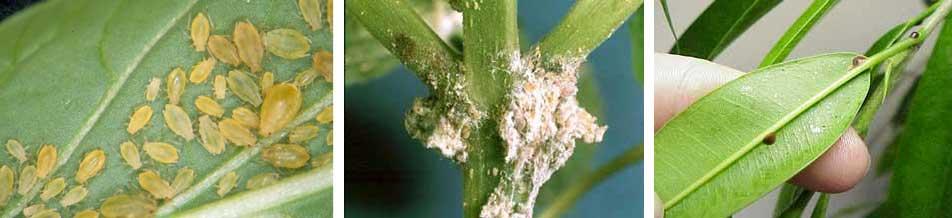
Left to right: aphids, mealybugs, and scale.
Spider mites: These are spider relatives, not true insects. They thrive in hot, dry air of heated homes. Look for leaves stippled with yellow and, when severe, fine webbing. Confirm by tapping an infested leaf over white paper to see tiny moving dark dots. Spray all leaf surfaces with water every few days for light infestations. For larger infestations, use insecticidal soap or horticultural oil, repeating treatments twice at five-day intervals. Keep humidity high around plants by lining trays with pebbles, filling with water to halfway up the pebbles, and setting pots on the pebbles.
Aphids: These small, soft-bodied insects cluster on tender new growth. Remove the most heavily infested growth by pinching it off. Spray with kitchen sink sprayer water or insecticidal soap for mild infestations.
Mealybugs: These appear as flattened, oval, cottony masses, often with white powdery wax extending in lacy filaments. Use a cotton swab dipped in rubbing alcohol to remove individual insects and egg masses, repeating weekly. For larger infestations, spray insecticidal soap or a mixture of one part rubbing alcohol to nine parts water. Newly hatched crawlers are most vulnerable to sprays.
Scale insects: These appear as small brown bumps on stems and leaves. Flick or rub them off by hand with a toothpick or tweezers, or dab with rubbing alcohol or mild dish detergent solution. For larger infestations, spray horticultural oil or neem oil at ten-day intervals when crawlers are active. Dead scale can remain on the plant for months.
Whiteflies: These tiny white insects hide on leaf undersides. Hang yellow cards coated with sticky substance close to plant tops. Use a vacuum cleaner set on low suction to remove them. Spray insecticidal soap, neem oil, or horticultural oil for larger infestations.
Aphids and Whiteflies in Gardens
The first line of defense is prevention. Check plants regularly. Avoid high-nitrogen fertilizers, which create young, succulent growth that these insects love. Isolate infested plants and control aggressively.
For whiteflies, hang yellow traps coated with sticky substance close to the tops of plants. Hand-crush small populations of young aphids and whiteflies. Encourage natural enemies in the garden by planting diversity and not spraying pesticides. As a last resort, use low-toxic sprays such as insecticidal soap, horticultural oil, and neem, repeating every few days until control is achieved.
Aphids can easily be removed by knocking them off with a water spray from a hose.
Beetles in the Vegetable Garden
Beetles are some of the most difficult insects to control organically because their hard shells protect them from sprays and they are mobile, flying around to feed on a variety of plants. Understanding their life cycle is essential for effective control.
Colorado potato beetles: These yellow and brown striped beetles lay masses of orange eggs on the underside of potato, eggplant, pepper, and tomato leaves. The eggs hatch into soft-bodied black and red larvae that quickly defoliate plants. There are 2 to 3 generations per year depending on region.
Control: Be vigilant. Identify the adult beetle in early summer and watch for clusters of orange eggs on the underside of leaves. Crush the eggs and you will reduce the population. Spray the larvae with Bt San Diego. Handpick the adults and drop them into soapy water. Grow resistant varieties such as 'King Harry' potato.
Japanese beetles: These emerge in early summer as metallic-colored adults that feed on a wide range of plants. They lay eggs in summer in lawn areas. Once a beetle finds a great feeding place, it attracts other beetles, so you get masses of them on your leaves.
Control: Get the beetles before they become adults. Spray beneficial nematodes or milky spore disease on the soil and lawn in late spring or early fall when larvae are in the upper reaches. Water well. Control the metallic adults by handpicking in the morning when they are sluggish, or place traps under favored plants and shake the beetles into them. Spray neem oil to discourage feeding.
Cucumber beetles: These are either striped or spotted with yellow and black. They emerge in spring, feed on weeds until their favored plants grow, and lay eggs in soil near the plant. Larvae feed on roots and pupate in the soil for a second generation. Their feeding damages leaves and stems and spreads bacterial wilt disease.
Control: Be ready for them in spring. Hang yellow sticky traps above plants (cucumber beetles are attracted to yellow). Cover plantings with floating row covers. Consider planting a trap crop of squash on the perimeter to lure beetles away. If you must spray, use pyrethrum-based sprays in the evening when bees are not flying. Grow disease-tolerant varieties.
Mexican bean beetles: These ladybug-like beetles with copper-colored shells and eight black dots lay bright yellow eggs on the underside of bean leaves. Yellow larvae hatch and feed, causing most of the damage. There are 1 to 3 generations per year.
Control: Crush masses of eggs on leaves. Handpick adults. Plant early-maturing varieties harvested before beetles become a major problem. Spray insecticidal soap, neem oil, and kaolin clay. Release Pediobius wasps to parasitize the beetles. Clean up crop debris in autumn to eliminate overwintering sites.
Seasonal Monitoring and Thresholds
Once you have identified the pest, research its life cycle and habits. Knowing when the insect is most vulnerable will help you time your controls for maximum effectiveness. Some pests, such as leaf miners that tunnel into plant tissue, will not be affected by sprays. Others are most vulnerable at specific life stages.
Determine whether control is really necessary. Is the damage located on leaves of a plant you will harvest in a week or two? Control may not be warranted. However, many pests multiply quickly, so keep a close eye on pest populations.
Environmental Considerations
Any pesticide (whether organic or conventional) can be harmful to a wide range of insects, birds, and soil organisms. Even biological sprays such as spinosad and Bacillus thuringiensis can have effects on beneficial insects and pollinators. Choose the method that best fits your garden and your comfort level.
A growing philosophy among gardeners is that preventing damage to the ecosystem and soil life is often more important than growing the perfect vegetable or flower. A plant with a few pest holes but healthy supporting ecosystem is often a better choice than a picture-perfect plant achieved through heavy spraying.
Final Thoughts on Pest Management
The key to successful pest management is starting with prevention. Grow the right varieties for your area. Build healthy soil. Rotate crops. Monitor your plants regularly. Identify pests correctly before acting. Use the gentlest control first: handpicking, barriers, or traps. Encourage beneficial insects by planting diversity and avoiding unnecessary sprays. Only when these methods have been exhausted should you consider a spray. And when you do spray, choose the most targeted, least-toxic option available.
This approach takes time and attention, but the rewards are a productive garden, a healthy ecosystem, and the satisfaction of working in harmony with nature rather than against it.
