


Sooner or later, every gardener discovers that good results, whether in the vegetable garden, the perennial border, or the lawn, depend on replenishing soil nutrients. Rain leaches nutrients down into the groundwater, some escape to the air as gases, and every basket of tomatoes you carry to the kitchen takes nutrients with it. Fertilizer is how you pay that account back. This guide covers how fertilizers work, the case for organic materials, and how to use each of the major types, from alfalfa meal to seaweed to the time-honored virtues of well-rotted manure.
What Plants Need
At least 16 nutrient elements are necessary for plant growth, but plants need three of them in quantity: nitrogen, phosphorus, and potassium, the N, P, and K on every fertilizer label. Nitrogen drives leafy growth, phosphorus supports roots, flowers, and fruit, and potassium underpins overall vigor and hardiness. Most soils hold large reserves of the other 13 nutrients, especially calcium, magnesium, sulfur, iron, zinc, and manganese, and some of those hitchhike along when you fertilize with the big three.
The only way to know what your soil actually needs is a soil test. Cooperative extension services in most states test garden soil for a nominal fee, as do private laboratories, and the results turn fertilizing from guesswork into a plan.
Organic or Synthetic?
Synthetic fertilizers are manufactured; organic fertilizers are derived from plants, animals, and naturally occurring minerals. Both can feed a plant, but they behave differently in the soil.
The great advantage of organic fertilizers is that their nutrients are doled out as a steady diet, in sync with plant needs. Because the nutrients are locked in natural materials, soil microbes must release them, and the warmth and moisture that speed microbial activity are the same conditions that make plants grow. Released slowly, organic nutrients rarely burn roots or leach away in rain, and a single application can last the whole season. The bulky organic matter that comes along with most organic fertilizers is a benefit in its own right: it improves soil structure, moisture retention, and drainage, feeds the soil's microbial life, and helps make nutrients already in the soil more available. Organic fertilizing also recycles materials, from lawn clippings to slaughterhouse by-products, that would otherwise be wasted.
Synthetic fertilizers have their own advantages: they cost less, are easier to transport, are uniform in nutrient content, and (except for controlled-release formulations, covered in our companion article on controlled-release fertilizers) act faster than organics.
One caution that applies even to organic products: the more concentrated a fertilizer, the less organic matter it contains, and high-nitrogen fertilizers used alone can actually deplete soil organic matter. Whatever you fertilize with, keep adding bulky organic materials, such as compost, straw, leaves, or peat, dug into the soil or laid on as mulch.
When and How to Apply
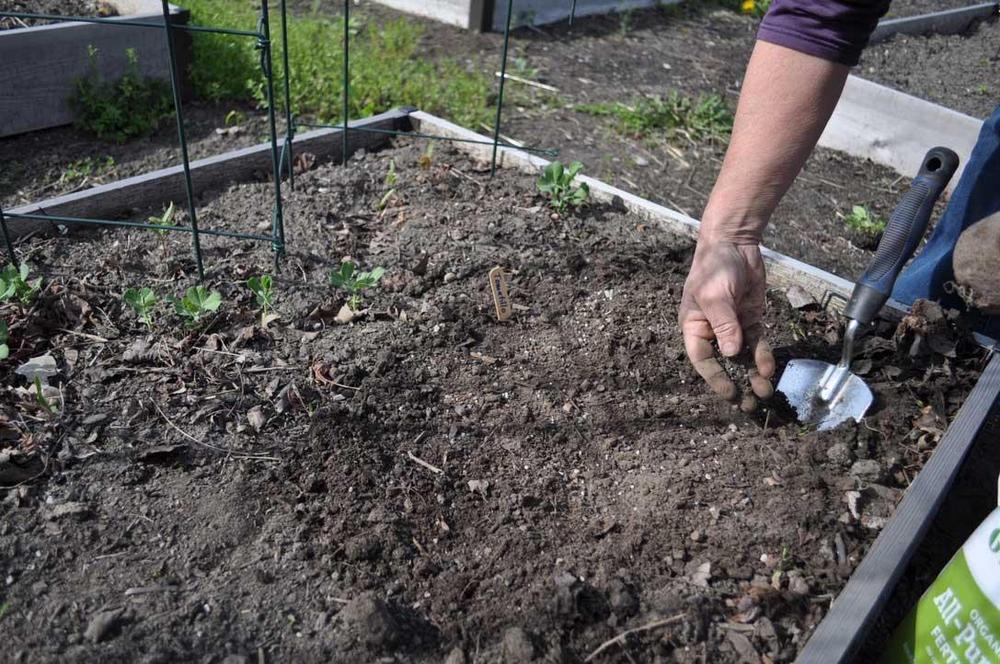
Timing. Because organic fertilizers need time for soil microbes to digest them, apply them well before planting: fall or early spring for a spring garden is ideal. The exception is liquid organic fertilizers such as fish emulsion, whose nutrients are readily available; use those at planting time or as a boost during the season.
Placement. There is usually no need to dig fertilizer in deeply. Feeder roots run in the top few inches of soil, and deep in the soil low oxygen slows the microbes that release organic nutrients. Simply spread fertilizer on the surface of the bed and mix it into the top few inches. The exception is phosphorus, which moves very slowly in soil: if a soil test shows phosphorus is low, mix the fertilizer into the top 6 to 12 inches where roots can reach it.
Rates. Amounts depend on your soil test and the particular material, but a rough rule for maintenance: apply about 2 pounds of actual nitrogen per 1,000 square feet (100 pounds of 10-10-10 contains 10 pounds of actual nitrogen). Apply phosphorus and potassium at about one-tenth that rate unless a soil test says otherwise.
Safety. Wear a dust mask when applying bonemeal, guano, or any dusty fertilizer; all dusts are potential lung irritants.
Plant-Based Fertilizers
Fertilizers made from plant substances and by-products are usually rich in nitrogen, sometimes in potassium, and count as renewable resources.
- Alfalfa meal (also sold as pellets) supplies moderate nitrogen (2 to 3 percent) plus some trace minerals; rose growers report good results using it as a mulch.
- Beet pulp, the dried, shredded remains of sugar beets after juice extraction, is rich in nitrogen.
- Corn gluten carries about 10 percent quickly available nitrogen and has the unique side effect of inhibiting seed germination, so it doubles as an organic pre-emergent crabgrass control for lawns.
- Cottonseed meal, a by-product of cottonseed oil pressing, is a slow-release fertilizer moderately high in nitrogen (about 6 percent) with some phosphorus, and it can acidify soil. Cotton is a heavily sprayed crop, so look for low-residue or pesticide-free meal.
- Soybean meal is similar to cottonseed meal but higher in nitrogen (about 7 percent); animal feed-supply stores often have the best price.
- Seaweed and kelp, in meal and liquid forms, supply potassium, a little nitrogen, and an unmatched spectrum of trace minerals; more on seaweed below.
Animal By-Product Fertilizers
The meat, dairy, and fishing industries yield several concentrated organic fertilizers.
- Blood meal is a rich, quickly available nitrogen source (about 14 percent); use it with care, and know that the smell can attract dogs and wildlife.
- Bonemeal is the classic organic phosphorus source (about 11 percent, plus roughly 22 percent calcium and a little nitrogen). Steamed bonemeal has less nitrogen but releases nutrients somewhat faster than raw.
- Fish products such as fish emulsion and fish meal can be rich in nitrogen (up to 10 percent) and act quickly; read labels, since nutrient content varies widely.
The Scoop on Manure
Animal manure is not glamorous, but it may be the most complete soil-improver a gardener can haul home: it adds organic matter and nutrients, boosts microbial activity, improves drainage in heavy soils, and improves moisture retention in sandy ones. The keys are knowing what kind you have, when to apply it, and how much to use.
Compost it first. Use manure that has been properly composted or aged at least six months. Fresh manure can carry pathogens such as E. coli and parasites; a hot compost pile that reaches 140°F minimizes those hazards (see Making Compost for the technique). If fresh manure is spread on a garden, do it the fall before planting. If you must apply uncomposted manure in spring, allow 120 days before harvesting leafy greens or root crops and 90 days before harvesting aboveground fruiting crops, and never use fresh manure as a side-dressing on growing plants.
Know your animal.
- Cow manure is the all-purpose standby and the most common bagged manure. Nutrients are low but moderately available, so it rarely burns roots; think of it as a soil conditioner as much as a fertilizer. Because cows digest their food thoroughly, weed seeds are well broken down. (Feedlot steer manure can run high in salts.)
- Chicken and other bird manures are the hottest: highest in nitrogen and phosphorus, quickly available, and quite capable of burning tender roots. Composted or diluted, they are excellent for leafy greens, and they carry few weed seeds.
- Bat and seabird guanos are concentrated and fast-acting (formulas like 10-4-2 or 14-11-2 are typical), useful early in the season to push vegetative growth. Like chicken manure, they can burn; steep them in water and apply as a liquid, or use them composted.
- Sheep and goat manure is drier and easier to handle than most, low in odor, and richer in nitrogen and potassium than cow or horse manure, though it can carry weed seeds.
- Horse manure is often the easiest to find locally and is a decent all-purpose product, but horses digest only about a quarter of what they eat, so it is notoriously weedy; compost it hot.
- Worm castings are odorless, rich in micronutrients and beneficial microbes, and gentle enough to use fresh. Nutrient levels are low, so castings, like compost, are really a soil amendment; stretch them by brewing them into a tea. You can buy castings or raise the worms yourself.
- Exotic manures from rabbits, alpacas, llamas, even zoo animals, are all usable; treat them like the farm manures above.
- Avoid entirely: cat, dog, and pig manure, which can harbor diseases that infect humans even after decomposition. Composted municipal biosolids ("sludge") are best avoided in food gardens too; if industrial wastes were included they can contain heavy metals, and they are not accepted in organic growing.
How much. As a general soil conditioner, use about 40 pounds of composted manure per 100 square feet, roughly a bag or two of the purchased product. On beds that are already fertile, a 1- to 2-inch layer worked in is plenty; on poor soils, double it.
Manure tea. For a quick liquid feed, steep a shovelful of composted manure (or a few handfuls of worm castings) in a bucket of water for a few days, strain, and water or spray it on. The tea delivers soluble nutrients fast, which makes it a fine mid-season pick-me-up.
Seaweed: The Micronutrient Specialist
Gardeners near the ocean learned long ago that seaweed is good for plants. Scientists have since found in seaweed a veritable soup of growth stimulants, vitamins, chelating agents, trace minerals, enzymes, and amino acids. The seaweed behind most garden products is the brown alga knotted wrack or rockweed (Ascophyllum nodosum), harvested from northern seas; a NPK analysis is modest (up to about 1.2 percent nitrogen, 0.2 to 1.3 percent phosphorus, and 2.8 to 10 percent potassium dry weight), but the trace elements and growth hormones are the real story. University studies have credited seaweed treatments with more flowers on geraniums, sweeter grapes, larger gladiolus corms, a 40 percent yield increase in cucumbers, and measurable gains in potatoes, sweet corn, peppers, tomatoes, apples, strawberries, okra, and oranges, along with better frost tolerance and seed germination.
When it helps most. Reach for seaweed when irregularly yellowed foliage suggests a micronutrient deficiency. Pinning down which micronutrient is missing is tricky without an expensive leaf-tissue analysis, and deficiencies often trace back to cold, compacted, poorly drained, or pH-extreme soil rather than the soil's actual nutrient content. In those situations a broad-spectrum seaweed spray is an efficient tonic while you fix the underlying soil problem. (For iron-starved citrus, synthetic chelates usually act faster.)
How to use it. Apply seaweed meal to the soil at 1 to 3 pounds per 100 square feet, or use liquid extract or powder as a soil drench or foliar spray. Typical dilutions run 1 to 2 1/2 ounces of liquid concentrate per gallon; mix powders like gravy, first into a paste, then into the full volume of water (about 1/4 teaspoon per gallon). Foliar-fed nutrients absorb within a day and travel throughout the plant. Spray a fine mist with a pressurized or backpack sprayer, coat the undersides of leaves as well as the tops, and spray in early morning or evening, never in midday heat. A spreader-sticker (or 1/4 teaspoon of liquid soap per gallon) helps the spray adhere. Respray if rain falls within a day, and hold off on overhead watering for a day after spraying. And resist the "more is better" impulse: studies show that above label rates, seaweed sprays can actually retard growth.
Free seaweed. Coastal gardeners can compost gathered seaweed for the same mineral benefits; check with local authorities first (collecting is regulated in many places) and rinse off the salt with fresh water.
A Note on Phosphorus
Most phosphorus fertilizer, from superphosphate to rock phosphate, comes from mined phosphate rock, a finite resource concentrated in a handful of countries. Alarms about imminent "peak phosphorus" have eased as reserve estimates were revised upward, but the long-term logic is unchanged: the supply is not renewable and prices can spike. Gardeners are well placed to use phosphorus efficiently: recycle it through animal manures and compost, grow tap-rooted cover crops such as field peas that mine phosphorus up from the subsoil, and apply phosphate fertilizer only when a soil test shows the need. For the full background, see the report A Rock and a Hard Place [PDF]. Mineral-based organic fertilizers, including rock phosphate, greensand, and their kin, are covered in Minerals for Soil.
Compost: The Cadillac
Compost is the Cadillac of organic fertilizers. Whatever mix of plant, animal, and mineral materials goes in, the finished product comes out remarkably similar: a modest but well-balanced spectrum of nutrients wrapped in humus so abundant that compost's greatest value is what it does for the soil itself. Use it freely alongside any of the fertilizers above, buy it commercially, or make your own and know exactly what went into it.
A last word in compost's spirit: do not spurn low-analysis organic fertilizers. Much of their benefit lies not in the NPK numbers but in the organic matter, which holds water and air in the soil, releases locked-up nutrients, and even helps suppress disease. Feed the soil, and the soil feeds the plants.
Curious about Epsom salts, the perennial back-fence fertilizer tip? See our companion article Fertilize with Epsom Salts for what they can and cannot do.
