

Introduction
An attractive evergreen shrub for warm climates, oleander produces heavily scented, colorful flowers all summer and fall.
About oleanders
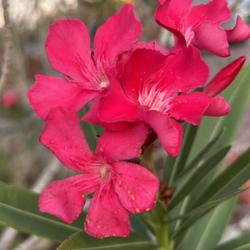
Oleanders bloom from summer to fall, with fragrant flowers in shades of apricot, copper, pink, lilac, red, purple, salmon, yellow, and white, depending on variety. The plants are best adapted to the west coast, southern states, Florida, and Texas and will withstand dry conditions and wind, as well as salty, marshy soils, making them popular in coastal regions. Oleanders grow 6 to 12 feet tall and wide, and some varieties can be trained to grow into small trees up to 20 feet tall. The flowers are very fragrant.
All parts of plant are poisonous to humans and animals if ingested; the plant's sap can cause skin irritation in some individuals.
Special features of oleanders
Fragrant
Choosing a site to grow oleanders
Ideally, select a site with full sun to light shade and well-drained soil. However, oleanders are adaptable and will withstand dry conditions as well as marshy soils.
Ongoing Care
Apply a layer of compost under the plant each spring, spreading it out to the dripline (the area under the outermost branches). Add a 2-inch layer of mulch to retain moisture and control weeds. Water plants during the summer if rainfall is less than 1 inch per week. Prune oleander after the main bloom period to encourage bushier growth and more flowers, and to reduce the size of the shrub.
Planting Instructions
Plant in spring or fall. Space plants 6 to 12 feet apart, depending on variety. Dig a hole only as deep as the root ball and 2 to 3 times as wide. If your soil is in very poor condition, amend the soil you've removed from the hole with a small amount of compost. Otherwise don't amend it at all. Carefully remove the plant from the container and set it in the hole. Fill the hole half full with soil, then water it well to settle the soil and eliminate air pockets. Let the water drain, then fill the remainder of hole with soil and water thoroughly.
Frequently Asked Questions about Oleanders
How poisonous is oleander, and what does that mean day to day?
Every part of an oleander is poisonous: roots, stems, leaves, flowers, seeds, and dried material. Nerium oleander carries cardiac glycosides, poisons that act on the heart, throughout the plant, and a small quantity of leaf matter or a swallowed seed is dangerous to people, to pets, and to livestock. The seeds hold the highest concentration of all. In some people the plant also provokes severe skin irritation from sap contact.
This is not a footnote to growing the plant; it shapes how you site it and how you handle it for as long as you own it.
- Site it away from where young children or pets play unsupervised. A poolside planting is a poor choice for exactly this reason, on top of the root problem described below.
- Wear gloves and long sleeves when pruning or handling it, and wash your hands and arms thoroughly afterward. Keep the sap out of your eyes, and do not touch your face or mouth while you are working.
- Bag prunings, fallen leaves, and seed pods and put them in the trash or a yard waste bin. Never leave a pile of clippings where children, pets, or livestock can reach it, and never add prunings to a brush pile where animals browse.
- Never burn oleander prunings. The smoke carries the toxin.
- Never use the stems for skewers, stakes, or anything else that will touch food or a mouth.
- Store collected seed in a sealed container out of reach of children and pets.
If a person or an animal has eaten any part of an oleander, contact a doctor, a poison control center, or a veterinarian immediately rather than waiting for symptoms.
Some people react to the plant strongly enough that removal becomes necessary, and a severe allergy is a legitimate reason to take an established hedge out. Keep that alongside the other hard fact about oleander: once established, it is exceedingly difficult to remove.
Which oleander did I buy, and how far apart do they go?
The whole spacing answer depends on whether your plants are standard Nerium oleander or a dwarf selection, and at the one-gallon size they look identical. The nursery tag is your only reliable guide. Standard oleander reaches 8 to 12 feet tall and nearly as wide, and it is what you have unless the tag says otherwise. Dwarf selections hold to roughly 3 to 5 feet.
Getting this wrong costs you either way. Space dwarfs at standard spacing and you leave permanent gaps in a screen. Space standards at dwarf spacing and you end up with a wall that has to be pruned hard every year.
- Standards: roughly 5 to 6 feet apart on center.
- Dwarfs: roughly 3 feet apart on center.
That is close enough for the plants to knit into a screen without starving each other.
How far from a house, a fence, or a pool should oleander be planted?
Oleander is unlikely to damage a house foundation. It forms a clump of stems rather than the single large trunk and heavy surface roots that make a tree a foundation risk.
Spacing still matters for the plant's sake. Planted a foot or two from a wall, an oleander grows wider every year until it is jammed against the building, and it needs light. Give it a minimum of about 4 feet from the house, and more if you have the room.
Off a fence, keep standards at least 4 to 5 feet back and dwarfs at least 2.5 feet, which is roughly half the mature width of the plant. That distance does two jobs: it keeps the shrubs from pressing against wood that then stays wet and rots, and it leaves you room to step behind and prune both the plants and the fence.
Poolside is a different answer. Oleanders have tenacious root systems, so a poolside planting is a bad idea on those grounds alone, and the toxicity argues against it as well where children and pets are running around the deck. Your local cooperative extension office publishes lists of plants suited to poolside use along with the characteristics to avoid, and that is the place to look for a substitute.
What kind of soil does oleander need? Is it acid-loving?
No, it is not an acid-loving plant. Oleander tolerates remarkably poor soil, including the rocky, dry, alkaline ground of the Southwest, which is exactly why it turns up in freeway medians and other inhospitable sites. The same is true of Texas sage (Leucophyllum, also sold as Texas ranger), which is native to the alkaline soils of Texas and Mexico. Neither shrub needs soil acidified for it.
Does oleander need fertilizer, and when should I apply it?
Desert adapted landscape shrubs generally do not need much. A 2 to 3 inch layer of compost mulched around the plant breaks down and releases nutrients slowly, and for many oleanders in the ground that is enough.
If you decide fertilizer is warranted, timing matters more than product.
Feed in late February or early March, as soil temperatures warm and fresh growth begins.
Do not fertilize as the weather heats up. Roots are vulnerable to damage from the salts in soluble fertilizer, the effect gardeners call burning, and heat makes it worse. Water the soil before and after any application.
A light second dressing in late September or early October is optional.
Follow the current label to determine how much to use rather than estimating. A soluble balanced product such as a 10-10-10 works, as do organic sources including fish emulsion and blood meal.
Container oleanders are a different case. Plants in pots do need feeding, because they exhaust the nutrients in their soil and their roots cannot spread outward to find more. Use a fertilizer intended for flowering plants or shrubs, follow the package instructions, and consider cutting the stated amount by half. Oleander is a tough plant that does not need coddling.
If you are new to fertilizer labels, the three numbers give the percentages of nitrogen, phosphorus, and potassium. Broadly, nitrogen drives leafy green growth, phosphorus supports stems and flowering, and potassium maintains a healthy root system. Organic nitrogen sources include alfalfa and cottonseed meals, blood meal, seabird guano, coffee grounds, and fish emulsion; for phosphorus, rock phosphate and bone meal; for potassium, kelp, seaweed, and greensand.
My newly planted oleander is dropping its lower leaves
Most likely transplant shock, particularly with a large container plant. A shrub from a 15-gallon pot suffers considerably more shock than one from a 1-gallon, and shedding the bottom leaves is how the plant copes, sacrificing lower foliage so the fresh growth at the top survives. If the remaining leaves and blossoms look fine, that is the pattern you are seeing.
Full sun is the correct exposure, so do not move it on that account.
Overwatering also causes leaf drop, and it is the more common mistake. An established oleander tolerates drought exceptionally well. Try easing off: allow the soil to go barely dry, then water slowly and deeply so moisture travels well below the roots. Weekly watering of an established plant is often more than it wants.
Why are the lower leaves turning yellow?
When the older, lowest leaves on a plant yellow, nitrogen deficiency is the usual cause, and a balanced landscape fertilizer applied at the label rate generally clears it up.
Read the pattern carefully, because a different one means something else: newer leaves turning yellow while their veins stay green points to iron deficiency instead, and nitrogen will not fix that.
My oleander stopped blooming even though it used to flower well
Check the light first. Oleanders need direct sun to bloom reliably, and if surrounding trees have grown up and shaded the shrub over the years, flowering declines.
The next most common reason is pruning timing. Oleanders bloom on new growth, with flower buds forming at the shoot tips as the season progresses, so pruning at the wrong moment removes the developing wood and eliminates that year's flowers. If you pruned in late spring or summer, you very likely took off the buds before they opened.
For an older plant that has stopped blooming, consider whether it needs rejuvenation. An old, densely branched shrub sometimes needs drastic renewal: cut it to the ground in late winter, before spring growth begins, and it responds with strong new shoots. Do not expect blooms in the first year after a cut like that, but the plant recovers and flowers on the new wood.
Bud feeding insects such as thrips and aphids are a less likely explanation for a long established plant that suddenly stopped, but if you see clusters of insects on new growth or damaged buds, check with a magnifying glass; thrips are tiny and hard to see with the naked eye.
When and how should I prune a mature oleander?
Oleander flowers on new growth, with buds forming at the shoot tips as the season goes on, and that single fact drives all the timing.
The best time to prune is early spring, before the main growing season, which gives the plant a full season to make new shoots, set buds at the tips, and flower. Avoid pruning in late summer or fall, because it pushes out tender growth that then gets caught by cold. Pruning in late spring or summer costs you that season's flowers: the plant carries on and sets buds on the next flush of wood, but the current display is gone.
How hard to cut depends on what the plant needs.
- A light shearing, removing just the outer growth, maintains shape and keeps the shrub full. To thicken a tall, leggy plant, take 4 to 6 inches off the tops and sides with hedge trimmers; it branches at every cut point and fills in through the center.
- Renewal cuts taken all the way to the base of a stem are what keep a screen dense and leafy from the ground up. A screen that gets renewal pruning stays useful. One that only ever gets tip pruning for size turns into a bare legged skeleton with all the foliage at the top.
- A hard cut to ground level rejuvenates an old, woody, sparse plant, at the cost of the following year's flowers.
Wear gloves for all of it, bag the clippings in a sealed container and put them in the trash, never burn them, never leave piles where children or pets could reach them, and wash your hands thoroughly afterward.
When is the best time to transplant an oleander?
When the plant is not in active growth and the heat stress of summer has passed. In cooler climates that may be fall; in warmer regions it may run into early winter. Look for the point where new growth has slowed.
Before you dig, cut the plant back by about half. This is a different operation from the growth-stimulating pruning above, and it serves a different purpose: it reduces the leaf surface losing water while the root system recovers from being dug. The plant is not being asked to make new growth, it is being resized to match the root damage that transplanting causes. This cut back is protective and necessary even when it falls in fall.
Dig out the root ball with as much surrounding soil as you can manage and transfer it onto a tarp, which makes moving it far easier and keeps the ball intact. At the new spot, plant at the same depth as before, firm the soil around the roots, and water well. Wear gloves throughout.
Frost killed the leaves and stems. Will the plants come back?
As long as the roots did not freeze, oleanders generally recover.
Do not rush to cut. Wait until you are confident the weather will stay above freezing, then prune off the frost damaged stems and leaves.
Where you cannot tell whether a stem is dead, wait for the plant to start growing. If new leaves emerge along the stem, it is alive. If nothing comes, cut that stem away where it meets the base and give the shrub time to send up healthy replacements. Plants trained as small trees at 5 to 8 feet are handled the same way.
What should I do with the seed pods on my young oleanders?
New oleanders often set seed pods before they are firmly established. You can remove the pods to put the plant's energy into growth, or keep them for propagation.
If you want the seed, wait until the pod turns tan or light brown and feels dry, and harvest as it just begins to split. Handle pods and seeds with gloves, because the seeds hold the highest concentration of the plant's toxins. Do not touch your face or eyes while you work, store the seed in a sealed container out of reach of children and pets, and wash your hands thoroughly afterward.
Be aware that seedlings may not match the parent plant's flower color. Cuttings are faster and more reliable if you want the same plant.
How do I root oleander cuttings?
Oleander propagates very easily, by two methods, and trying both to see which suits you is reasonable.
In water. Take tip cuttings about 6 inches long and strip the lower leaves, since roots form at the leaf scars and nodes. Cut the remaining upper leaves back to about an inch to reduce water loss. Stand the cut ends in water in a container set outdoors in shade, changing the water every four or five days. Roots form in a few weeks. Once they are an inch or two long, pot the cuttings into potting soil, keep them shaded for a few weeks, then move them gradually into sun.
In potting mix. Take 4 to 6 inch cuttings of new growth, strip the lower leaves, dip each cut end in rooting hormone, and insert it into moistened potting soil. Rooting takes several weeks and varies with temperature and light. Keep them sheltered until you see new growth, then move them gradually to a sunnier spot.
Wear gloves for this work and keep cuttings and trimmings away from children and pets, since every part of the plant is poisonous.
Are oleander caterpillars a real problem?
They are real, and if you plant oleander you will very likely get them eventually.
The adult is a striking bluish to purplish moth with white dots on black wings (Syntomeida epilais), which flies actively around oleander shrubs and can be mistaken for a wasp. The damage comes from the larvae, which are orange with black hairs and black spots. Mated females lay clusters of 25 to 75 orange eggs on leaf undersides. The hatched caterpillars first skeletonize the leaves and later consume them entirely. Full grown larvae spin silk cocoons and emerge as adults, which live about five days. The whole cycle takes about 60 days, and there can be three generations a year.
The important part for a worried gardener is that the damage is purely aesthetic. The caterpillars can strip a great many leaves, but a healthy plant replaces them and carries on, and in time nothing suggests there was ever a problem. Oleander caterpillars feed only on oleander.
This pairing is common enough to have a name, the key plant and key pest concept. Crape myrtle and crape myrtle aphids, azalea and azalea caterpillars, camellia and tea scale, rose and black spot, and pecan and pecan scab all work the same way.
So whether to spray comes down to your own tolerance for temporary damage. If you cannot live with it, a product containing Bacillus thuringiensis targets caterpillars specifically. Use only a product whose current label names oleander and the pest, at the label rate and with the label's protective equipment and reentry period, and store it out of reach of children and pets. Understand the tradeoff: it harms any caterpillar that eats treated foliage, including butterflies you want. If you are gardening for butterflies and moths, some caterpillars have to survive to become adults.
I sprayed for scale and now the whole shrub is drooping
Scale insects favor oleander above most hosts, and unchecked they really do damage the plant, so treating is reasonable. The drooping usually comes from the timing of a horticultural oil application rather than from the pest.
Oil suffocates scale, but it also coats the leaves. Applied in midsummer, that coating intensifies sunlight on the leaf surfaces and suppresses the leaves' ability to transpire, and drooping follows. The residual oil weathers away over repeated rainfalls and the plant generally recovers as it does. There is no product that removes it faster.
The lesson is about timing: apply horticultural oil outside the heat of midsummer, and follow the current label, which will state its own temperature restrictions. Any insecticide you use must carry a current label naming oleander and the pest you have identified, applied at the label rate with the label's protective equipment and reentry period observed, and stored out of reach of children and pets.
Is there any reason not to plant a whole row of oleander?
In California and the desert Southwest, oleanders are vulnerable to a bacterial disease called oleander leaf scorch, spread by sharpshooter insects. It kills the shrub branch by branch and there is no cure. A long single-species screen in those regions risks losing the whole row to one disease.
The honest practical advice is to mix in a different shrub at intervals, so that if leaf scorch takes out the oleander your screen is not gone entirely. That is a good idea anyway; a mixed screen usually looks better than one plant repeated down a fence line.
How do I get rid of an established oleander for good?
Understand what you are up against. Cutting the shrub to a stump and hoping it fades away does not work, and neither does repeated cutting: oleander resprouts from the crown and comes back thicker.
The plant is removed only by taking out the crown. That means getting down there with a shovel and chopping out the crown area, and often a stump grinder as well to destroy the remaining buds. The stump itself can extend a couple of feet below ground. A chain saw, a backhoe, and a stump grinder are the tools that get it done, and you can rent the equipment or hire a certified tree worker or arborist.
On cost, ask for itemized local estimates, because what a quote covers varies. Pricing turns on where the plant sits and how big it is, and a quote may or may not include chipping, cleanup, and hauling the foliage away. Shrub removal is typically quoted per foot of plant, stump grinding per inch of stump diameter, and grinder rental by the day. Published figures from some years ago ran up to about $25 per foot for a mature shrub, something in the range of $2.50 to $4.00 per inch of stump diameter ground out, and day rental of a grinder around $79. Treat those as an illustration of how the work is priced rather than as current prices.
Chemical shortcuts are worth a caution. Gardeners report spraying various products and even drilling the stump and pouring chemicals in, only to have the plant return thicker. Any herbicide you use must carry a current label that names the plant and the site, applied only at the label rate with the label's protective equipment and reentry interval, and kept away from desirable plants nearby. Mechanical removal of the crown is what actually ends the plant. While you work, wear gloves, and bag and dispose of the debris out of reach of children and pets rather than burning it.