

Introduction
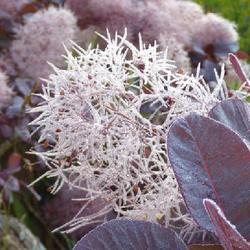
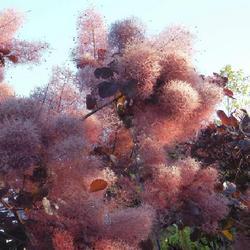
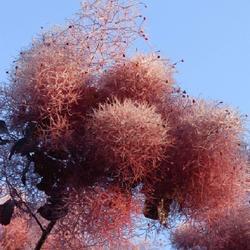
The Smoke Tree is most widely known for its large billowing
summer blooms that have a puffy cloud-like or "smoky"
appearance. The large blooms provide an attractive characteristic
as they wisp in the air with a gentle summer breeze.
About smoketrees
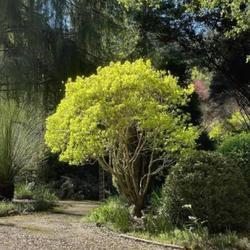
The smoketree is most widely used as a specimen tree, with its attractive "smoke-like" inflorescences appearing in early to late summer. As clusters of tiny blooms fade away in the late spring, this plant shoots out hairy-like filaments, producing an attractive "smoky" billowing plume. Selections include varieties with green or purple foliage, changing to shades of orange, red, or purple in autumn. It has a rounded form, growing approximately 10 to 12 feet high and wide, but sometimes as tall as 20 feet. It is hardy in Zones 5-9. Smoke bush can thrive in a wider range, hardy in virtually all regions from USDA Hardiness Zone 4a through 11, with excellent fall color especially valued in colder regions where few other plants compete with its dramatic foliage.
Choosing a site to grow smoketrees
The smoketree is very easy to grow and drought resistant as well. It prefers well drained or dry soil conditions and full sun but can also tolerate partial shade conditions. A single tree can act as a focal point or feature in the garden; when planted in groups of three or more, smoketrees can make a very vibrant display as a hedge or colorful backdrop for your other garden plantings.
Planting Instructions
Be sure to dig your hole at least twice as wide as the container size and mix in a shovelful of compost when planting. When setting your plant, be sure that the top of the root ball is slightly higher than the grade surrounding the perimeter of the dug hole. Fill the remainder of the hole with well drained soil and water.
Ongoing Care
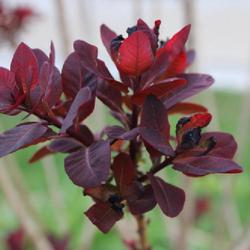
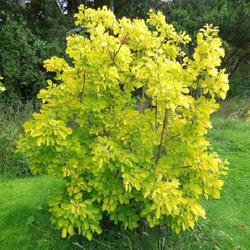
Once established, a heavy spring pruning can help force the most colorful new growth for a display of color and multiple shoots. Keep in mind that dry summer conditions promote a very showy and vibrant fall color to your smoketree. <a href="http://garden.org/plants/view/76091/Smoke-Tree-Cotinus-coggygria-Royal-Purple/" target="_blank">Royal Purple</a> variety is well known for its deep purple foliage and red-purple autumn fall color. The new growth of <a href="http://garden.org/plants/view/126950/Smoke-Tree-Cotinus-coggygria-Golden-Spirit/" target="_blank">Golden Spirit</a> emerges bright gold, changing to lime green in summer and shades of orange and red in fall.
Other fine selections include 'Velvet Cloak' (reddish purple leaves, turning brilliant deep red in fall with purply pink smokes), 'Daydream' (blue-green leaves turning red-orange in fall, hardy and vigorous), and the pink hybrid 'Grace' (large leaves about one-third larger than other cultivars, with bright pink smoke-like flower clusters, though it requires pruning to maintain a bushy form).
Pruning and Rejuvenation
Water the shrub during dry spells, especially during establishment. For the first two or three years, fertilize lightly in spring with organic plant food, but avoid overfertilizing; excess fertility produces coarse, lanky growth and diminishes fall color intensity. Keep in mind that where smoketrees grow along lawn edges, be careful not to overfertilize nearby grass, which could encourage late growth vulnerable to frost damage.
Smoke bush flowers on second-year growth. For rejuvenation, cut the shrub to the ground in fall and mulch; it is a fast grower that will produce vigorous new growth full of color in one season, though it will not flower that year. Otherwise, simple rejuvenation pruning in spring to remove the oldest, woodiest stems is all that's needed.
Disease Note
The primary concern is Verticillium wilt, a soilborne fungus that causes sudden dying back of branches. Proper drainage is critical to avoid infection. Affected plants must be replaced as there is no cure. Otherwise, smoketrees are relatively disease- and insect-free.
Common Questions
When is the best time to prune a smoke tree, and how should I do it?
Early spring, before growth begins, is the safe answer and the one to follow if you garden where winters are cold. You will find sources recommending a cut in late summer after the smoke fades, and that is the timing to avoid in a cold climate: pruning stimulates a flush of new shoots, and growth pushed that late in the season does not have time to harden before winter, so it dies back and you lose more than you removed. An early spring cut puts the whole growing season in front of the new growth instead.
How far to cut depends on what you want from the plant.
For shaping and size control, reduce the plant by roughly a third each spring, cutting back to a bud or a side branch rather than leaving stubs. Done annually, this keeps a smoke tree bushy and within bounds and is enough maintenance for most gardens. Thinning out the oldest and woodiest stems at the same time keeps the interior open.
For a complete renewal, the shrub can be cut hard, down to about a foot above the ground, and it will rebuild quickly from the base. Where winters are cold, make that cut in early spring rather than in fall so the regrowth has a full season to mature. Remember the tradeoff described in the care section above: smoke tree flowers on second-year wood, so a hard renewal cut sacrifices the smoky plumes for that year in exchange for a flush of the brightest possible foliage. Gardeners who grow the purple and gold selections mainly for leaf color often make that trade deliberately, on a cycle of every few years.