

Introduction
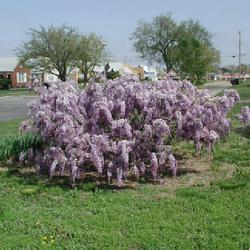
Wisteria are vigorous, twining vines that bloom in spring with huge, cascading flower clusters.
About wisterias
Wisteria is notable not only for its attractive, fragrant flowers, but also for its vigorous growth. The vine may grow 10 feet or more in one year, and can easily overwhelm nearby plants and structures. Heavy annual pruning is necessary to keep it in bounds. The vines become large and woody with age and need sturdy support. Flower colors include blue, red, lavender, and white, depending on the variety.
Special features of wisterias
Fragrant
Choosing a site to grow wisterias
Select a site with full sun to light shade and well-drained, deep, moist soil.
Planting Instructions
Plant in spring or fall, spacing plants 10 to 15 feet apart. Dig a hole only as deep as the root ball and 2 to 3 times as wide. If your soil is in very poor condition, amend the soil you've removed from the hole with a small amount of compost. Otherwise don't amend it at all. Carefully remove the plant from the container and set it in the hole. Fill the hole half full with soil, then water it well to settle the soil and eliminate air pockets. Let the water drain, then fill the remainder of hole with soil and water thoroughly.
Ongoing Care
Apply a layer of compost under the plant each spring, followed by a 2-inch layer of mulch to retain moisture and control weeds. Water plants during the summer if rainfall is less than 1 inch per week. To control growth and encourage flowering, prune wisteria after flowering in early summer by cutting side shoots that arise from main stems back to 6 inches. In fall, shorten these same laterals back to 2 to 4 buds. Remove shoots arising from the base of the plant as soon as they appear.
Frequently Asked Questions about Wisterias
Which wisteria do I have, and does it matter?
It matters more than anything else on this page. Three species are widely grown, they look similar in bloom, and they differ in when they flower, when they should be pruned, how young they bloom, and whether they belong in your region at all.
Wisteria floribunda, Japanese wisteria is the most widely grown of the three. It blooms first, typically in April, before or as the leaves unfold, and it comes in many cultivars.
Wisteria sinensis, Chinese wisteria blooms in May, also before or with the emerging leaves, and is the most powerfully fragrant of the three. It is hardy to roughly 10 to 20 degrees F.
Wisteria frutescens, American wisteria, including the widely sold 'Amethyst Falls', and Wisteria macrostachya, called Kentucky or northern wisteria, including 'Blue Moon', are the native alternatives. They bloom June through August, after the vine has leafed out, on shorter, denser clusters carried on the current season's growth. They are less vigorous, which is a considerable advantage in a garden, and they flower far younger than the Asian species, often within two to three years of planting a grafted or cutting grown plant. American wisteria is hardier than it is usually given credit for, taking roughly minus 15 to minus 20 degrees F, which puts it in zones 5 through 9.
The bloom habit is the clearest field difference once a vine flowers: the Asian species carry long, narrow, trailing clusters on bare wood, with the individual flowers arranged densely along one elongated raceme, while American and Kentucky wisteria carry shorter, more pyramidal clusters after the leaves are out and bloom over a longer period rather than all at once. If you cannot tell your plant apart with certainty, check the tag, ask the nursery, or ask your extension service or a native plant nursery before you decide what to do with it.
Should I be planting an Asian wisteria at all?
Chinese and Japanese wisteria have escaped cultivation and are seriously invasive across much of the Southeast, mid-Atlantic and Ohio Valley, and increasingly westward, where they smother native vegetation, climb and girdle standing trees, pull down power lines and take over stands of mature forest. Several states regulate their sale and a few prohibit it. Invasiveness is regional rather than universal, and in parts of the West, including British Columbia, Asian wisteria has not become a problem, so check your own state or county invasive species list before you plant.
Where they are invasive, plant American or Kentucky wisteria instead. If you already have an established Asian vine, keep it on a structure you can reach and prune, do not let it climb into trees, do not let seed pods scatter into adjoining woodland, and do not dump prunings or pods in a hedgerow or woodland edge. Growing Asian wisteria from seed in an invaded region is multiplying exactly the problem; container culture only, or no planting out at all, is the responsible path there.
The convenient part is that the ecological recommendation and the horticultural one point the same way. The natives are the ones that bloom young.
My wisteria will not bloom. What is wrong with it?
Work through these in order.
Immaturity, which is the commonest answer and the hardest to accept. Roots can need five to seven years to establish before a vine flowers at all. A seed grown Asian wisteria can take seven to fifteen years and sometimes never flowers. A two or three year old Asian seedling growing beautifully and not flowering is behaving normally, and that is good news rather than a diagnosis. An American or Kentucky wisteria at three years, on the other hand, is a fair candidate for corrective pruning.
Not enough sun. Wisteria needs six or more hours of direct sun to flower. Shade produces exactly the healthy leafy growth you are looking at, and a vine gradually shaded out by a growing tree canopy will flower less every year. No amount of feeding or pruning substitutes for light.
Too much nitrogen. Wisteria needs very little. Rich soil or a nitrogen fertilizer produces rampant leafy growth at the expense of flowers, and a general purpose plant food used on the rest of the garden is often exactly the wrong thing here. A vine planted in or beside a regularly fed lawn takes up lawn fertilizer whether any was aimed at it or not. Stop feeding it, and if it stands in turf, take the grass back and mulch an island around the base, keeping the mulch off the trunk itself.
Pruning at the wrong time, or not at all. This is where most of the fixable failures are; see the next two questions.
Two remedies get passed around and deserve straight answers. A high phosphorus feed to force bloom does not work, because phosphorus applied where the soil is not short of it is not taken up as a bloom trigger, and the surplus suppresses the beneficial soil fungi that help roots work while running off into waterways. Get a soil test if you want to know your phosphorus status. Hitting the trunk with a rolled newspaper does nothing at all. The nitrogen point above is the fertilizer issue that actually matters.
Finally, a vine that has bloomed before and then skips a year may simply have lost its formed buds to a hard late frost, which happens to Asian wisteria in a cold spring.
When should I prune, and what are the actual cuts?
The timing follows from the species. The Asian species set their flower buds in fall for the following spring, so they are pruned after flowering. Cutting them back hard in the dormant season removes next spring's flowers, and that is the single most common self inflicted cause of a bloomless vine. American and Kentucky wisteria flower on the current season's growth, so they take their hard pruning ahead of the spring flush.
The annual cycle for an Asian wisteria on a pergola, arbor or wall, where the numbers matter more than the tidiness:
- Through the growing season, pinch or cut out the tips of new shoots once they reach about 12 inches, and repeat all summer as new streamers appear. This is what stops a vine running away, and it is the routine most gardeners skip.
- In midsummer, roughly July into August, take out the straggly, overlong growth, keeping only the branches you need for climbing and structure, and cut the long whippy new shoots back to about six inches from the main stems, leaving five or six buds on each. This is not a gentle tip pinch, it is a significant cut, and of everything here it is the likeliest to bring a stubborn vine into flower, because shortening those shoots is what makes the plant build the short spurs that carry next season's clusters. Repeat on any long shoots that appear over the following weeks.
- In winter, while the vine is bare, shorten those same stubby shoots again to two or three buds. Each remaining bud can carry a flower cluster.
- At any time, cut away all suckers at the base.
Beyond that, avoid extensive dormant pruning, which tends to be answered with a burst of vegetative growth the next spring. The flowers form on the short spurs, never on the vigorous long stems the vine wants to make, so keep the structural framework, cut only the extension growth, and never strip the plant back to bare wood or remove the spurs. With a season or two of practice the fat, rounded flower buds become easy to tell from the slim pointed leaf buds, and after that you can prune confidently, taking the streamers and leaving the flowers.
Should I cut my wisteria to the ground to make it start over?
No. A severe cut to the base throws the vine back into vigorous juvenile growth and guarantees another run of years without flowers, however tempting it is when you are frustrated. The two stage summer and winter pruning above is what actually works.
If the correct pruning has not worked after two or three faithful seasons, and you have confirmed the vine genuinely has full sun, root pruning is the traditional last resort. In fall, drive a sharp spade vertically into the ground in a circle several feet out from the trunk, working all the way around. It stresses the plant enough that it sometimes shifts from growth into flowering. It is not risk free, it works sometimes rather than reliably, and most gardeners never reach this step.
Will my arbor hold a mature wisteria?
Only if it was built for one. Wisteria is extraordinarily heavy and strong at maturity, thirty feet or more of woody vine given the chance. It collapses light arbors, works its way into gutters, siding and shingles, and girdles and kills any tree it is allowed to climb. A structure meant to carry a mature vine needs substantial posts set in the ground and rails that will take the weight, and it is far easier to build that now than to rebuild it under an established vine. Never train a wisteria into a living tree, however good the effect looks at the start.
How do I train wisteria as a standard or a weeping tree?
A standard, with a clear trunk and a flowering canopy above, is a striking feature, and American wisteria such as 'Amethyst Falls' trains well to it. Plant in the center of an open, sunny spot with light coming from all directions and drive a sturdy post in beside it. Tie the strongest, straightest stem loosely to the post to train it up as the central trunk, and pinch or prune off the side shoots from that stem for the first year or two so the plant puts its energy into height and trunk strength. Once the trunk reaches the height you want, stop removing side branches and let them build the canopy, then prune regularly to shape it and to take out branches growing downward or inward. Head back the young shoots each year to hold the plant at its set height; over several years the stem thickens into a trunk, and then the leaders can be allowed to fall away toward the ground. The whole process spans several growing seasons.
Underneath all of it: good garden loam, full sun, and thorough watering through the first growing season.
What are the fuzzy green pods, and should I remove them?
They are the seed pods, the fruit of the vine, and they dry and split open as they mature. Removing them or leaving them makes no difference to the plant, so it is your choice with two things weighed in.
Wisteria seeds and pods are toxic to people and to pets, and they are the part of the plant most likely to be swallowed. They contain wisterin and lectins, which cause violent vomiting, intense abdominal pain, profuse diarrhea and dehydration, with symptoms starting within an hour or two. As few as two or three seeds have caused serious illness requiring hospital treatment in children. The velvety pods look enough like edible beans that children and pets are tempted by them, and they are easily pocketed, mouthed or chewed. Where there are children or animals about, inspect the vine through the season, cut the pods off before they mature and get them out of the garden rather than letting them drop, and do not bring dried pods into the house. Every part of wisteria is toxic, not only the seed. If a child or an animal eats any part of the plant, contact Poison Control at 1-800-222-1222 in the US, or a veterinarian, at once rather than waiting for symptoms, and have the plant material available to show them.
The second reason is that where Asian wisteria is invasive, taking the pods off keeps the vine from seeding itself around.
Remove pods as part of your regular pruning rather than as a separate late season cutting session. On an Asian wisteria that has just flowered for the first time, resist a big tidy up in early fall: next spring's buds are already being set, and heavy cutting now costs you the display you waited five years for.
Should I grow wisteria from seed?
Only if the growing is the point. A wisteria from seed commonly takes ten to twenty years to flower and sometimes longer, and when it does, the blooms may differ from the parent in color, fragrance, size and season. A grafted plant or one grown from a cutting of a named variety flowers in two to four years and matches the parent exactly. If you want flowers soon, buy a plant that is already in bloom or one propagated vegetatively from a named clone, and ask the nursery directly whether it is seed grown or cutting grown; if they are unsure, keep looking. The grafted plant costs more and saves you a decade.
Seed is worth it if you want to raise a plant from its beginning, to produce seed from a vine you already have, or to see which seedlings might flower earlier. It is also the practical path if you have no access to cuttings and the vine is hard to layer. Go in with your eyes open about the timeline.
If you want more of a vine you already have, the fast and faithful method is semi-hardwood cuttings taken in early summer.
How do I collect, prepare and sow wisteria seed?
Collecting. Pods appear in late summer and ripen to tan or brown by mid to late fall. Wait until they begin to crack or split naturally on the vine, which is when the seed inside has matured, then cut them off with scissors or pruners. Break the dried pods open by hand or crack them gently with a small mallet and shell out the seeds, three to five per pod, cleaning off debris and fluff. Fresh seed is best, because germination rates fall rapidly once seed has been dried and stored for months, so sow within days or weeks if you can. If you must hold seed over winter, keep it in a sealed container in a cool dry place, check it for mold, and sow in spring. Wear gloves for all of this, wash your hands afterward and before handling food, label the seed clearly, keep it sealed and out of reach and out of sight of children and pets, never leave extracted seed on a bench unattended, put pod fragments in the trash in a sealed bag rather than the compost, clear up bits and fragments as you go, and tell children explicitly that the seed and pods are poisonous.
Scarifying and soaking. The seed coat is hard and slows water uptake. Nick or scrape each seed with a file, medium grit sandpaper or the tip of a small knife, working over a paper towel, just enough to break the smooth outer surface without cutting into the embryo; you should see a faint scored line. Some growers skip this and simply soak, which is gentler and needs no tools. Either way, soak the seed in tepid water for 24 hours, then drain and sow immediately. Do not soak longer than a day, since prolonged soaking rots the seed.
Sowing. Wisteria needs no cold stratification. Sow in late winter or early spring in a moist, well draining, sterile seed starting mix, since damping off fungi kill seedlings and cleanliness matters. Firm the mix gently for good contact without compacting it, press each seed about an inch deep, and cover the flat loosely with a dome or plastic wrap to hold humidity without sealing it. Keep the medium consistently moist and cool, ideally 55 to 65 degrees F; warmer conditions around 70 degrees also work but germinate more slowly and less evenly. Expect seedlings in 30 to 35 days. If germination is sparse at that point, do not throw the flat out, since some seed is slow and some waits until the following spring.
Growing on. As soon as seedlings make their second or third set of true leaves, move them into individual pots in a light fertile mix rather than leaving them in the seed mix, which they exhaust quickly. Keep them consistently moist, give them bright light, and harden them off gradually if they are going outside: a week of sheltered bright indirect light, then morning sun with afternoon shade, then more direct sun. A sheltered spot with morning sun suits the first year. Watch for spider mites indoors, which show as fine webbing and tiny yellow speckling; a spray of water or insecticidal soap used per its label handles them.
Then wait. A seedling can put on several feet in a season, which is encouraging and deceptive, because flowering is tied to maturity rather than size. Give it full sun, do not overfeed it, water it consistently for the first two seasons to build a deep root system and then let it experience some dry periods, and prune only to guide it onto its support or to remove damage. No fertilizer, pruning method or folk trick forces an immature seedling into flower before it is ready.
There are ants all over my wisteria and the tips are dying back
The ants are a symptom. Look for aphids and you will almost certainly find them clustered on the growing tips. They are small soft bodied insects that suck sap, and the sugary honeydew they excrete is what the ants are farming, which is also why the ants are on this plant and not on its neighbors and why there are none at the roots. You may see dark sooty mold growing on the sticky residue as well.
Knock them off with a strong jet from the garden hose, which on a woody vine is effective and often sufficient, and repeat every few days. If that is not enough, use insecticidal soap: choose a product whose current label covers ornamentals and aphids, apply at the label rate, follow the label's protective equipment and reentry directions, and store it out of reach of children and pets. Do not improvise a homemade soap solution, which can burn foliage and is not a labeled use. If ladybugs have arrived, do nothing at all, since they clear an aphid population remarkably fast and spraying kills them too.
Then fix the cause. Aphids are drawn to soft tender new growth, which is what oversupplying nitrogen produces, so if you have been feeding this vine, stop, which is also the right move for flowering. Aphid pressure is usually worst in early summer and eases as predators catch up, so a vine attacked in June often looks fine by August with nothing more than the hose.
Wind snapped my wisteria trunk. Can it be saved?
It is worth trying, and if the repair fails the plant is still very likely to survive, so there is little to lose.
Fit the broken ends back together as precisely as you can, the way you would fit a chipped china cup, then bind the join firmly. Add a splint on the outside if the join will not hold on its own, using anything rigid and small, down to a wooden clothespin on a slender trunk. Grafting tape is the right wrap and electrical tape will do. Then take the load off the join: tie the vine to its support in several places both above and below the break, and cut the top back to reduce the sail area the wind can push against. That combination is what gives the repair a chance through winter storms. Then wait until spring and see what leafs out.
If it fails, you have not lost the plant. An old wisteria sits on an enormous root system and regrows quickly from the base. The thing to do then is resist letting it come back as a thicket: choose one or two of the strongest suckers, cut out all the rest, and train the survivors up in place of the old trunk. Given that root system, a replacement stem gains size fast.
My newly planted wisteria has withered. Is it dead?
Probably not. Newly planted wisteria commonly suffers transplant shock, wilting and looking dead within weeks of planting. Scrape a little bark: green tissue underneath means the plant is alive. Water deeply once a week, do not let the soil dry out completely, prune the withered stems back to encourage new growth, and be patient, since recovery can take a few months. A vine planted in spring has the whole season to establish roots. Do not dig it up and replant it until you have given it at least a full growing season.
Can I grow wisteria where winters are severe?
American wisteria at a zone 5 rating, about minus 20 degrees F, is comfortably hardy through winters that average between zero and 15 above, but a cold snap reaching minus 20 to minus 30 goes past it. So in the coldest gardens the vine is close to viable and needs help in the hard years rather than being hopeless. A south facing wall is the best site, since it absorbs winter sun and shelters the plant from drying winter wind.
Expect dieback and plan around it. In a severe winter the vine will likely be killed back to the ground or nearly so, and here the species works in your favor: American wisteria flowers on the current season's growth, so a plant that resprouts from the base can still bloom that same summer, which would not be true of a Japanese or Chinese vine.
Check whether your plant is grafted before you count on it coming back. Look at the base for a swelling an inch or so above soil level, which indicates a graft, since the rootstock thickens faster than the grafted top. On a cutting grown plant, whatever regrows from the roots is the variety you bought; on a grafted plant, what returns from below the graft is the rootstock and not the named cultivar. If you are unsure, have a nursery look at the base.
For protection, put three to four inches of mulch over the root zone, and deeper is better, but keep it pulled back about six inches from the trunk rather than piling it against the stem, since mulch held against bark keeps it wet and invites rot at exactly the point the plant can least afford it. Insulating the top growth is harder and still worth attempting: pile a whole tree's worth of fallen leaves over the plant and do not pack them down, because the air trapped between the leaves is what insulates, while compressed wet leaves insulate poorly and rot the stems. If wind will scatter the pile, lay burlap over it and weight the edges with rocks or bricks, then pull it all off in spring as growth starts.
I want a fragrant vine on an arbor, but I am worried about bees
Be honest with yourself about what you need. No plant covered in nectar and pollen is going to be free of bees. If you truly cannot tolerate them, the answer is a non-flowering screen rather than a different flower. If it is a minor concern and you simply want fewer encounters, site the vine high on the arbor and keep the foot traffic area below it clear. American wisteria is less fragrant than the Asian species but still has a pleasant scent, and it is the one to choose east of the Rockies; do not pick Chinese wisteria for its fragrance in a region where it is invasive.
How far from buildings and septic systems should a wisteria be planted?
Keep a wisteria at least 15 to 20 feet from any building, trained on a free-standing structure rather than anything attached to the house: established vines work into siding, under eaves, and through gutter systems, and they are extremely difficult to remove from a structure without damage. Keep it 20 to 30 feet from septic systems, drainage fields, and water lines, because the root system is extensive and competitive long before the vine reaches full size.