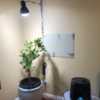
Window light would be negligible at best. In general, a 36 watt (true LED consumption) is appropriate for one square foot of growing area at about two feet. Obviously that can't happen for any but one level of the foliage. Bu inverse square law, if the light is two feet above the top foliage, the foliage two feet lower will bet on one-quarter of the light. Even much less than that, since the upper foliage will shade it out. In your first picture, you can see the great difference in light intensity.
We deal with this sort of thing all the time in hydroponic where so often, the only light is artificial. In large growing environments, higher power lights are mounted much higher, so that the percentage difference from top to bottom of the plants is of no concern. But it is a common problem in smaller environment, like grow tents. Lower foliage can suffer greatly.
You can't make up for it by mounting the light close to the top. That can damage the top foliage. If I had the problem, I think I would move the tree to the side or away from the wall, so that I could direct the light from the side so that most of the length of the tree was always within the range of 1.5 to 3 feet from the light, and I would rotate the tree frequently to give all of it a shot at light. If that light arm has a lot of extension left, it would be nice if the bulb could be moved away from the wall to look back at the tree from about a foot lower. It would still need to be rotated.
But you get the idea, and you may be able to work out an even better way to light most of the tree evenly and with enough light.
And I don't know if you know this, so I'll say it anyway, since I don't see any obvious timer. Artificial light for plants should follow their preferred natural day/night cycle. Plants use the light in building energy supply during the day and use the energy during dark hours. They need both.
Citrus needs a minimum of six hours of sunlight or equivalent. Ten hours is probably a good average. The hours of light affect the character of the tree. At six hours of direct sun, they tend to be shorted and bushier. With eight to ten hours, they grow taller and broader. A simple timer is all you need.
The tree will let you know when you get it right. If it doesn't have enough light, new leaves will be small, because it doesn't have the energy to make them large. And it may get unnaturally taller and leggy as it reaches for the weak light. Rotating it will also help keep it symmetrical by not having it favor one light direction. There are nice plant caddies with wheels to make it easy.





 but I want the plant to be happy