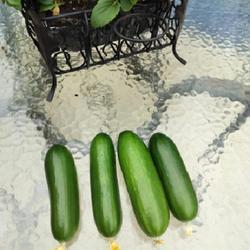


Introduction
For a heat-loving plant, the cucumber has all the connotations of coolness attached to it. Sliced cucumbers are still recommended to soothe hot, tired eyelids and for skin irritations. And there's nothing like sliced cucumbers in a summer salad to beat the heat.
About cucumbers
There are many cucumber types, including picklers, slicers, gherkins, white, and bush cukes. The art of pickling and preserving cucumbers is centuries old. You can pickle or preserve any small cucumber, or eat picklers fresh right off the vine, so experiment with different varieties, regardless of how you intend to use them. In general, picklers are smallish, often warty, green, used for small sweet pickles or large dills, but the can also be eaten fresh. Slicers form 5- to 8-inch cylindrical cucumbers, used for slicing and serving fresh. Cucumbers grow best with long, hot, humid days with maximum sunshine and warm nights. Plants are extremely susceptible to frost.
Choosing a site to grow cucumbers
Select a site with full sun and well-drained soil. Prepare the garden bed by using a garden fork or tiller to loosen the soil to a depth of 12 to 15 inches, then mix in a 2- to 4-inch layer of compost.
Planting Instructions
Sow seeds outside only after danger of frost when soil has warmed. Make a second sowing four to five weeks later for a late summer or early fall harvest. For an earlier harvest and to reduce the threat of insect damage to seedlings, start a few plants indoors in individual pots about a month before your last spring frost date.
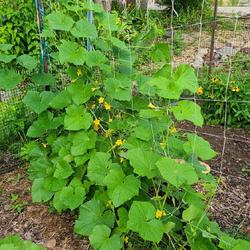
To seed in rows, plant seeds 1 inch deep and about 6 inches apart. To plant in hills, plant four or five seeds in 1-foot-diameter circles set 5 to 6 feet apart. Set up trellises for plants to climb on. Trellised cukes are straighter and have fewer insect and disease problems.
Growing Cucumbers in Containers
In many ways, containers and cucumbers are a perfect match. Cucumbers love the warm soil a container provides, so you can plant earlier in spring and harvest longer into the fall. It's easier to keep an eye on the demanding water needs of cucumbers when they're grown in pots on a deck or patio close to the house. Space-efficient varieties are quick maturing and high yielding, making them ideal for containers.
Plant Bush Varieties
Bush varieties offer good disease resistance and yield high-quality crops in much less space. These plants have a bushy, round shape as opposed to a more viney growth habit, with shorter spaces between the leaves. They branch quicker and tend to set fruit sooner and closer to the base of the plant. Even bush varieties like 'Pick a Bushel Hybrid' will produce yields comparable to standard-sized vines.
Parthenocarpic varieties set fruit without pollination and are ideal for containers. 'Arkansas Little Leaf' (also called 'H-19 Little Leaf') has small, triangle-shaped leaves and produces abundant two- to three-inch picklers throughout the season.
For a mix of varieties, select monoecious types that bear both male and female flowers. 'Fanfare' is an excellent choice for a bush-type slicer with increased disease resistance.
Gynoecious varieties produce only female flowers and can be highly productive. 'Bush Baby' is a compact gynoecious variety with uniform pickles and a more compact habit than similar varieties.
Choose Pots and Soil Mix
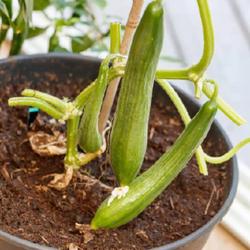
Use wooden or plastic containers that are 12 inches deep and about the same diameter for each two to three plants. Clay pots dry out too quickly for cucumber needs. Make sure the container has at least four drainage holes on the sides at the base. Use a soilless mix, such as two parts peat, two parts vermiculite or perlite, and one part fine sand. A mix with sand is heavier but holds water and fertilizer longer. Mix a time-release fertilizer such as Osmocote in the soil before planting. Most varieties benefit from trellising; a tomato cage fitted to the container works well, keeping cucumbers straight and clean.
In cool climates, place containers in a south-facing exposure for full sun. In climates where summer temperatures reach the 90s, avoid black plastic containers and give pots an eastern exposure. Elevate them at least four inches off the ground.
Proper Watering is Critical
Push a pencil or popsicle stick into the soil; if soil sticks to it, you don't need to water. If it comes up clean, it's time to water. Add liquid fertilizer diluted to half strength once a week if plants need a boost. Always water from the top of the container until water comes out the bottom to leach any fertilizer salts out.
Succession Plant for Steady Harvest
Bush varieties produce fruit for roughly four weeks during the summer. About two weeks after you start picking cukes, plant another crop. Most bush types mature in about 50 days, so by overlapping plantings you can get at least two, sometimes three crops a year in a container. For best flavor, harvest pickle cucumbers at three inches long and slicers at 8 to 9 inches long.
Ongoing Care
Thin cucumber plants in rows to 1 or 2 feet apart, depending on the variety, when 3 to 4 inches tail. Thin cucumber plants in hills to the healthiest two plants when plants have two or three leaves. Keep soil evenly moist to prevent bitterness in cucumbers. Apply a thick layer of mulch about 4 weeks after planting. Contact your local County Extension office for controls of common cucumber pests such cucumber, squash vine borers, and whiteflies.
Troubleshooting Cucumbers
Poor Pollination
Cucumbers produce separate male and female flowers on each plant. In order to get fruit, bees and other pollinating insects need to visit the flowers. If the weather is too cloudy or cold, the bees don't fly and your flowers don't get pollinated. Additionally, there has been a dramatic population decline in bees and pollinating insects.
Gynecious cucumber varieties have been bred to produce mostly female flowers, which increases the chance that plants will produce fruit. Each packet of gynecious cucumbers comes with a male pollinator variety that needs to be planted to ensure proper pollination. Gynecious varieties include 'Slice Master Hybrid', which produces heavy yields; 'Olympian Hybrid', an early-maturing slicer with great disease resistance; and others.
Parthenocarpic varieties produce self-fertile female flowers and don't need pollination to produce fruit. 'Diva Hybrid' is an All-America Selections winner producing sweet, nonbitter, crisp-textured 4- to 5-inch slicing cucumbers with resistance to scab and tolerance of powdery and downy mildews. 'Tyria Hybrid' is a Dutch variety that grows well indoors and outdoors, producing 14-inch-long, lightly ribbed, dark green fruits.
Insect Pests
Cucumber beetles are the most destructive pests of cucumbers. These 1/2-inch-long, black and yellow beetles are either striped or spotted. They feed on young seedlings and flowers, and also transmit wilt disease between plants. To control them, cover young plants with floating row covers. Periodically check under plants for beetles that slip inside. Yellow cards covered with a sticky substance such as Tanglefoot can catch and kill beetles. Sprays such as neem oil and pyrethrum are also effective.
Squash bugs are brown or gray, 1/2-inch-long bugs that attack leaves and deform plants. Crush the bronze-colored eggs on the undersides of leaves and spray young and adult bugs with pyrethrum.
Aphids can be controlled with a jet spray of water. Pickleworms tunnel into developing fruits, causing rot. Use floating row covers to protect young fruit on parthenocarpic varieties, and spray pyrethrum on other varieties.
Diseases
Many cucumber varieties are disease tolerant or resistant. Tolerance means the plant can get the disease but it won't kill it or affect yield. Resistance means the plant is protected against getting the disease.
Some varieties with excellent disease tolerance and resistance include 'Eureka', which tolerates angular leaf spot, scab, watermelon mosaic, zucchini yellows, cucumber mosaic virus, anthracnose, and powdery mildew. 'Slice Master' tolerates scab, cucumber mosaic virus, anthracnose, and downy and powdery mildew. 'Olympian Hybrid' tolerates scab, angular leaf spot, and downy and powdery mildew.
Clean up plant debris in fall, space plants properly, mulch, and keep plants healthy with water and fertilizer to prevent diseases.
How to harvest cucumbers
Once cucumbers reach pickling or slicing size, harvest every couple of days to prevent cukes from getting overly large or yellow and to keep plants productive. Pickling varieties seem to go by their peak the fastest.
Frequently Asked Questions about Cucumbers
What size should I pick cucumbers at?
Harvest size is the single most useful number here, because picking late causes several of the problems below.
- Pickling cucumbers: about 4 inches long.
- Slicing cucumbers: 5 to 7 inches long.
Pick regularly, not just when you need one. Every fruit left to mature on the vine signals the plant that it has done its job, and flower production drops off. Keeping the fruit picked keeps new flowers and new cucumbers coming.
Overmature fruit also has a specific cost in eating quality: the seeds inside develop hard coats, and once that happens the cucumber is not going to improve no matter how you prepare it.
Why are my cucumbers mostly big seeds with hardly any flesh?
Water, almost certainly. A cucumber is about 98 percent water, and a plant that cannot get a steady supply during fruit development gives up on filling out the fruit and puts what it has into making seed instead. Seed is the plant's actual purpose; the flesh is for us.
Picking early helps only a little, as you have probably found, because the problem starts before the fruit is picking size.
Fix it at both ends:
- Before planting, work plenty of organic matter into the bed. Compost, leaf mold or peat moss all raise the soil's capacity to hold water, which is what turns an irregular watering schedule into an even supply at the roots.
- Through the season, water thoroughly rather than lightly, and pay particular attention once fruits start swelling. That is the window in which the flesh is either laid down or not.
- Mulch with straw, grass clippings or leaves. Organic mulch keeps soil moisture even, which is exactly what evens out growth and yield.
There is no cultivar that will rescue you from dry soil. Some varieties are less seedy than others, but water is the variable doing the work.
What causes misshapen cucumbers, and what about deposits on the skin?
Fruit shape and flavor both respond to growing conditions, and four causes account for most of it: uneven watering, incomplete pollination, excessive heat, and mineral imbalance in the soil.
Uneven moisture does more than produce seedy fruit. It disrupts calcium uptake, and since the cells of a fast growing fruit need calcium as they expand, the result is blossom end rot, a sunken dark patch at the blossom end. The soil almost always contains enough calcium. It is the water supply failing to deliver it.
Incomplete pollination produces fruit that swells unevenly, often bulbous at one end and pinched at the other. Every cucumber needs many visits from bees to be fully pollinated. Heat is a factor here too, since pollen dies in extreme temperatures, which is why misshapen fruit clusters in the hottest part of summer. Training the vines up a trellis helps a great deal: it lifts the flowers where pollinators can find and work them, and it keeps the fruit hanging straight.
Deposits on the skin have a few possible explanations. A dry, flaky crust may be salts precipitating out of irrigation water, and the check is easy: if that is the cause you will see the same deposit on the soil surface and on other surfaces the water touches, not on the cucumbers alone. A clear ooze appears wherever insect feeding or a physical scrape has broken the skin. And on a fruit that has contracted rather than expanded smoothly, the spines can be crowded together closely enough to look like a crystalline coating.
If none of those describe what you are seeing, your county extension office can look at an actual sample, which is worth far more than a description. That is the right next step for anything unusual on a food crop.
Why did a cucumber turn yellow or orange and stop enlarging?
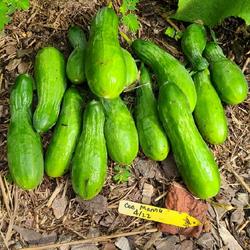
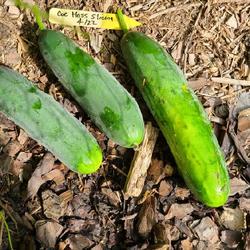
A color change by itself is not enough to identify the cause. Some cucumber types naturally mature yellow, including the lemon shaped types, while ordinary green cucumbers become yellow or orange when they stay on the vine past their useful harvest stage. Small fruit can also simply mean a different cucumber type than you expected. Compare the fruit's shape and progression with the seed label, the plant tag, or a reliable identification reference.
To tell a naturally yellow cucumber from an overmature ordinary one, check the cultivar first, then compare fruit picked at progressively earlier stages against the variety's expected size, shape, and color. A naturally yellow type shows those characteristics consistently as it develops. An ordinary cucumber that starts green and changes color after lingering on the plant is behaving like overmature fruit.
If it is neither variety nor maturity, look at several fruits and at the whole plant. Note whether the change affects fruit at the same stage, whether growth stops, and whether there are soft or collapsed areas, lesions, insect activity, leaf symptoms, or stem problems, then check recent weather, watering, and any chemical or fertilizer exposure. Those observations narrow the possibilities without establishing a diagnosis. Photograph the pattern and get a local extension, nursery, or crop specialist assessment if symptoms spread or the plant declines.
Should I eat a cucumber that has changed color?
Color is not an edibility or safety test. Do not assume an unfamiliar fruit is suitable to eat, and do not infer the cultivar, the best eating stage, or safety from color alone. Follow the identified variety's harvest guidance and use your own food safety judgment, discarding produce that is spoiled, damaged, or otherwise questionable. If the plant was treated with any product, follow that product's current crop label and its preharvest interval before harvesting. And do not treat an unknown condition with fertilizer or pesticide in the hope of fixing it.
Do I really need to pinch off the early flowers to get fruit?
No. This is exactly backward. Cucumbers carry both male and female flowers on the same plant, and the first flush is almost entirely male, producing pollen but no fruit. Do not pinch them off. It looks like the plant is wasting energy on flowers that will not set, but it is actually preparing to pollinate the female flowers that come later, and pinching removes the pollen you need.
If your vines are taking over the garden, the fix is to train them up a trellis, or let them sprawl and prune back the vines themselves to keep them in bounds. Trimming vines sacrifices some later fruit but solves the space problem. Pinching flowers does nothing useful.
I want to grow the small, thin-skinned cucumbers I buy at the grocery store. Can I find seeds?
Those are the Persian type, a market category within Cucumis sativus, an ordinary garden cucumber. What sets them apart is the cultivar: they are usually a Beit Alpha group, meaning thin skinned, small at 4 to 5 inches, mostly seedless, and largely parthenocarpic, so they set fruit without needing pollination. That last trait is why they do well under row cover or shade cloth.
In seed catalogs, search for "Persian cucumber" or "Beit Alpha" and check that the species label says Cucumis sativus. They are grown the same way as any other cucumber and mature in the same 50 to 70 days.
There is another plant worth knowing about because it is not what you are after. The Armenian cucumber is Cucumis melo, a melon rather than a garden cucumber. It is long and ribbed and eaten like a cucumber, which is where the confusing name comes from. If a catalog lists "Armenian cucumber," check the species: if it says Cucumis melo, set it aside and keep looking.
What are the ideal growing conditions?
Worth stating plainly, since most of the problems here are conditions problems.
- Soil pH around 6.5 to 7.0.
- Soil texture rich, humusy, and well drained.
- Mulch of straw, grass clippings or leaves over the root zone.
- Support on a trellis, for pollinator access and straighter fruit.
- Water thorough and consistent, especially during fruiting.
My cucumber plants are wilting and dying one at a time. What is it?
If the plants have sun, water, fertility and decent soil, a plant that wilts and collapses on its own schedule is a disease. Two families of disease do this and they call for completely different responses, so identify which you have before doing anything.
The knife test for bacterial wilt. This is a genuine field diagnostic and takes about a minute.
- Cut through a wilted stem close to the base of the plant.
- Squeeze the cut end and look for sap oozing out. Bacterial wilt sap is milky white.
- Touch the tip of a knife blade to the ooze, then draw the blade slowly away.
- If the ooze follows the blade in a fine thread as you pull back, the plant has bacterial wilt. A clean separation with no stringing means it is something else.
Bacterial wilt is carried by cucumber beetles, which infect the plant while they feed on it. That matters for control, because there is no chemical treatment for the wilt itself once a plant has it. Pull and dispose of infected plants. What you can act on is the beetles, and the more durable answer is to grow resistant varieties, which sidesteps the whole cycle.
If you do treat for cucumber beetles, remember you are treating a food crop that depends on bees. Use only a product whose current label names cucumbers and cucumber beetles, apply at the label rate, wear the personal protective equipment the label lists, and observe both the reentry interval and the days to harvest interval printed on that label. Do not apply where bees are working, and avoid open flowers entirely, since a cucumber with no pollinators sets no fruit at all. Store products away from children and pets, and wash all harvested cucumbers.
The soil fungi, fusarium and verticillium wilt, present a different pattern. The symptoms progress rather than appearing all at once: leaves turn yellow, then brown, then die, and the lower leaves go first, working upward. These diseases build up when cucumbers are grown in the same ground year after year, and the fungus survives the winter in the soil. Because it lives in the soil, control is cultural: clear away crop residue at the end of the season, rotate cucumbers to different ground on a multi year cycle, and choose resistant varieties. There is no spray that fixes a soil fungus in a home garden.
My cucumber leaves have holes in them. Do I need to spray for ants?
Probably not. Ants rarely eat plants themselves. If you see ants on cucumber leaves, they are usually tending honeydew producing insects such as aphids or scale for the sweet residue those insects excrete. The ants are a symptom, not the problem. Check the plants closely with a magnifying glass, looking on stems and leaf undersides for clusters of soft bodied pale insects, and if you find aphids, spray them off with water daily for a few days and they will decline.
The likelier cause of actual holes is cucumber beetles, which are yellowish with black spots or stripes. They do two things: they eat the foliage, which is obvious but usually not fatal, and they carry bacterial wilt, which is. An infected plant wilts suddenly and dies, and there is no cure once it has it. That is why controlling beetles on young plants, before the plant is big enough to flower, matters more than the leaf damage itself. Row cover over young plants until they flower is the practical answer. Once the flowers open you need pollinators, so remove the cover and accept a few beetles; by then the plant is large enough to tolerate the feeding.
What about earwigs, ants, and grubs in the garden?
Earwigs feed on dead organic matter and other insects, not live plants. Unless the population is huge and food is short they will not damage healthy plants. They hide in dark moist places during the day, which is what makes two traps work: a shallow dish with a half inch of water and a film of oil floated on top, set under the plants, or moistened newspaper rolls placed in the garden at dusk and collected each morning with the earwigs inside. Both lower the population over time. Having some earwigs around is not a problem; they eat aphids too. Put oil traps where children and pets cannot get at them, and empty and refresh them regularly.
Ants are generally harmless in a garden. When they are on your plants they are usually tending aphids or another honeydew producer, so they point at a bigger problem rather than being one.
Grubs are the likely culprit if cucumber roots are being eaten. Once they are established in the soil they are hard to control, but you can reduce numbers for the following season by tilling the soil thoroughly at the end of the growing year, which exposes them to birds and weather.
I pulled up a cucumber plant and the roots have white knobby bumps all over them
Those are galls from root knot nematode, a microscopic worm that lives in soil and attacks the roots of many vegetables. The nematodes enter the roots and cause the plant to form those characteristic lumps. If you have read about nitrogen fixing nodules on beans and peas, those look similar but occur only on legumes, never on cucumber.
Nematodes are difficult to eliminate but they can be managed:
- Rotate away from susceptible crops. Cucumbers, tomatoes, peppers, eggplants, lettuce, and many flowers are hosts. Brassicas such as cabbage, broccoli and Brussels sprouts, and alliums such as onion and garlic, are not.
- Grow resistant varieties. Some newer cucumber, tomato, and pepper cultivars carry resistance to root knot nematode.
- Use solarization: in very hot weather, water the soil deeply, cover it with clear plastic for four to six weeks, then plant. The heat kills many nematodes in the upper layer.
- Add organic matter, which helps plants withstand nematode stress and sometimes lowers populations over time.
My other vegetables are stunted and my tomatoes are yellowing. Are the cucumbers overpowering them?
Partly, but the bigger issue is usually soilborne disease carried over in the ground.
Yellowing that starts on the lower leaves and moves progressively up a tomato, especially on a plant that is wilting despite adequate water, is the classic sign of a soilborne wilt disease. That is very different from normal aging, where the oldest leaves drop off but the rest of the plant stays vigorous and green. If you replant tomatoes in the same soil year after year, disease pressure builds.
Crop rotation works because different plant families carry different soil diseases. Group your vegetables by family and rotate on a three year cycle:
- Solanaceae: tomato, pepper, eggplant
- Brassicaceae: cabbage, broccoli, cauliflower, Brussels sprouts, kale
- Cucurbitaceae: cucumber, melon, squash, pumpkin
Do not plant a solanaceous crop where you grew tomatoes, peppers, or eggplants the year before.
Beyond rotation, the practical answer to crowding is to trellis the cucumbers. They are aggressive vines, and sprawling across the ground they shade their neighbors and compete for water and nutrients. Training them up a support gets them off the ground, improves air circulation, and gives the rest of the bed room.
I planted luffa seeds and I am getting something that looks like an oversized ridged cucumber. Is this a gourd or a vegetable?
That is luffa, a gourd, related to cucumber and squash. Luffa (Luffa acutangula or Luffa cylindrica, depending on variety) looks like an oversized cucumber on the vine and even tastes somewhat similar picked young, but it is a different plant. The key differences: luffa has pronounced ridges running lengthwise rather than a smooth skin, it is not the hard ornamental gourd type, and it needs a very long warm season to mature.
Young luffa picked at 4 to 6 inches is edible and tasty. But the reason most gardeners grow it is the mature fibrous interior, the sponge you scrub with, and getting there takes 80 to 100 frost free days of warm weather. If your season is short or cool you may never reach sponge maturity, and the plant will spend the year making fruit that never ripens. Before planting luffa, consider whether you have 80 or more days of reliably warm weather. If not, stay with regular cucumbers, which mature in 50 to 70 days and will actually produce a harvest.
How long does a cucumber plant live? Mine stopped after two months
That is normal, and nothing has gone wrong. Cucumbers are annuals. They grow, they fruit heavily for a stretch, then they decline and die, and setting a crop of fruit accelerates the process.
The response is to sow again rather than to nurse the old plants. Pull the finished plants and start a fresh sowing, and you will be picking roughly six weeks later. In a long season or a warm climate that is the basis of a good routine: sow a short succession every few weeks and replace each planting as it fades, rather than having one flush and then nothing.
Can I plant cucumbers near a black walnut tree?
Walnut roots release juglone, which poisons many garden plants. Cucumbers are in a reasonably good position here, but distance matters more than most people expect.
Which plants are actually at risk. The nightshade family suffers most: tomatoes, peppers, eggplants and potatoes either die outright or grow stunted. Asparagus, blueberries, raspberries, apples, and several cole crops are also reported as sensitive. Cucumbers and their relatives in the squash family do not appear on the lists of especially sensitive plants.
Why caution is still warranted. Absence from a sensitivity list is not the same as proven tolerance, and a vegetable bed is a season's work. A sensible compromise is to treat it as a trial: put a few plants in the questionable spot deliberately and plant the rest of the crop at a safe distance. Then you learn something about your own site without risking the whole planting.
What the safe distance actually is. Far greater than the 5 to 10 feet beyond the drip line that the question usually assumes. The goal is to site beds clear of the tree's root zone altogether, and that zone is set by the size of the tree. For a mature walnut, a radius of 50 to 60 feet from the trunk is easily required. For a young tree, roots can reach out to about twice the tree's height, so a 15 foot tree can have roots running 30 feet out, well beyond anything visible above ground.
The part that is easy to forget. Juglone leaches from fallen leaves and nuts as well as from roots, so a garden sitting outside the root zone can still be dosed by leaf litter blowing in. Rake out any walnut leaves and nuts that land in the beds, and keep them out of compost destined for the vegetable garden.
Something ate my cucumbers and left the skins. What was it?
Plenty of candidates, and the fence you built for rabbits does not exclude most of them. Foxes, raccoons, squirrels, rabbits, rats and mice all eat cucumbers happily. Rodents in particular squeeze through very small gaps and tunnel under fencing, so an intact rabbit fence tells you little.
Do not assume it was a mammal, either. Slugs, snails and beetles will eat out the flesh of a cucumber and leave the skin behind, and on a fruit resting on the ground they are the more likely culprits. Check the fruit at night with a flashlight, which is when slugs and snails feed.
The reliable answer for either is a physical barrier on the fruit itself rather than a campaign against the animal. Slip a short length of old pantyhose over each ripening cucumber, or tie a square of cheesecloth around it. Both let in air and light, both expand as the fruit grows, and both stop the raiders. For a handful of fruits nearing harvest this is quick and it works.
Two things not to do. Do not put out rodent bait in a vegetable garden, where it is within reach of children, pets and wildlife and sits alongside food you intend to eat. And do not salvage a partly eaten cucumber; discard anything that has been gnawed, since you cannot know what fed on it.