

Introduction
An easy-to-grow perennial, geranium is often used in borders, rock gardens, and as a ground cover. Another common name is cranesbill.
About geraniums
Geranium is a diverse group containing types that grow in a range of conditions, from full sun to shade. Flower colors include pink, blue, white, and purple. Most geraniums blooms in midsummer, although some species will bloom in spring and fall. Plants grow 6 inches to 4 feet tall, depending on the variety. These true geraniums are not the annual flowers commonly grown in windowboxes, which are more properly referred to by their botanical name, Pelargonium.
Special features of geraniums
Easy care/low maintenance
Multiplies readily
Deer resistant
Choosing a site to grow geraniums
Select a site with full sun to light shade and well-drained soil. In hot climates, choosing a site with moist soil and afternoon shade will improve vigor and prolong bloom.
Planting Instructions
Plant in spring, spacing plants 6 inches to 2 feet apart, depending on the variety. Prepare the garden bed by using a garden fork or tiller to loosen the soil to a depth of 12 to 15 inches, then mix in a 2- to 4-inch layer of compost. Dig a hole twice the diameter of the pot the plant is in. Carefully remove the plant from its container and place it in the hole so the top of the root ball is level with the soil surface. Carefully fill in around the root ball and firm the soil gently. Water thoroughly.
Ongoing Care
Apply a thin layer of compost each spring, followed by a 2-inch layer of mulch to retain moisture and control weeds. Water plants during the summer if rainfall is less than 1 inch per week. Cut back the plant after flowering to stimulate new growth and reblooming. Divide plants every 3 to 4 years as new growth begins in the spring, lifting plants and dividing them into clumps.
Variety Recommendations
Geraniums are available in a wide range of colors and growth habits suited to different garden situations.
For shade: The native East Coast wildflower G. maculatum (zones 4 to 9) has pale pink flowers fading to cream. G. nodosum (zones 5 to 9) forms colonies in deep shade with light lilac to dark pink funnel-shaped flowers. G. phaeum (zones 3 to 9), particularly the form 'Samobor' with maroon-blotched leaves and reddish flowers, creates an imposing clump. G. endressii 'Wargrave Pink' (zones 5 to 9) is a well-known shade variety. The numerous varieties of G. oxonianum (zones 5 to 9), such as 'A.T. Johnson' (luminous pink), 'Phoebe Nobel' (dark pink), and 'Winscombe' (pale to dark pink), perform well in shade to partial sun.
For ground cover: G. macrorrhizum 'Ingwersen's Variety' and 'Czakor' (zones 3 to 9) are aggressive weed-smothering ground covers that remain evergreen in mild winters. The less aggressive G. cantabrigiense (zones 4 to 9) offers varieties like 'Biokovo' (white with pink flush) and 'Cambridge' (mid-pink).
For rock gardens and containers: G. cinereum 'Ballerina' and G. cinereum subcaulescens (zones 4 to 9) are compact with distinctive gray-green foliage. G. sessiliflorum 'Nigricans' (zones 8 to 10) forms a neat brown-leafed mound. G. dalmaticum (zones 4 to 9) has small leaves with pale pink flowers in late spring.
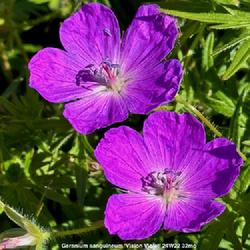
For perennial borders: G. sanguineum (zones 5 to 9) should be on every gardener's list, with fine forms like G. sanguineum striatum with pale pink flowers and deep pink veins, 'Cedric Morris' with large light magenta flowers, and the pure white 'Album'.
Blue flowers: G. magnificum (zones 5 to 9) produces five weeks of violet-blue flowers. The hybrid G. 'Spinners' (zones 4 to 9) has deep blue flowers with hints of mauve. 'Johnson's Blue' (zones 4 to 9) is clear sky blue. G. wallichianum 'Buxton's Variety' (zones 6 to 9) is light blue with a white center. G. himalayense (zones 5 to 9) has deep blue flowers with red center fades, and the double form 'Birch Double' offers smaller lilac-blue flowers. G. pratense 'Mrs. Kendall Clarke' is pale gray-blue with gray veins.
White flowers: G. clarkii 'Kashmir White' (zones 3 to 9) produces large white flowers with lilac veins and faint lavender wash. G. riversleaianum 'Mavis Simpson' (zones 8 to 9) has a very long flowering season with pale pink flowers.
Magenta flowers: G. psilostemon (zones 5 to 9) forms an imposing clump with black-eyed magenta flowers. The hybrid 'Ann Folkard' (zones 5 to 9) is a spreading plant with purplish-magenta flowers and chartreuse leaves, blooming from spring to fall.
Propagation
Propagate species types from seed. Named varieties such as 'Johnson's Blue' must be propagated by division of the crowns or by root cuttings in early spring.
Regional Considerations
Most hardy geraniums are hardy to about -20 degrees F (zone 5), with some much more cold tolerant. One species, G. pratense, can withstand temperatures to -50 degrees F (zone 2). Growing geraniums in southern regions with high summer heat and humidity may require a midseason cutback of leaves to renew plants. Give G. pratense extra mulch around its roots in regions with very hot summers.
Frequently Asked Questions about Geraniums
Three different plants carry these names. Which one is this?
Sorting this out first saves you applying the wrong advice.
Cranesbill is Geranium, the hardy herbaceous perennial grown in borders and as ground cover, and everything on this page is about it. The name comes from the long beaked seed capsule.
Storksbill is Erodium, a related but distinct genus, mostly smaller alpine and rock garden plants. It is not what a nursery sells you as cranesbill.
The bedding geranium is Pelargonium, the tender plant sold in flats for pots and window boxes every spring. It is not hardy, it is not a cranesbill, and its care has almost nothing in common with the perennial. If that is what you have, see the guide for pelargoniums.
Why does my cranesbill go brown and fall apart after it flowers?
Because that is what it does, and there is a single cut that fixes it.
A hardy geranium builds a mound of fresh foliage in spring, flowers, and then declines. The center opens up, the stems sprawl outward, and the older leaves brown and go either crisp or mushy depending on the weather. On the vigorous border kinds this happens every year without fail. It is not a disease, it is not a pest, and it is not something you have done wrong.
Shear the whole plant back hard, close to the ground, as soon as the main flush of flowers is over and the foliage starts to look tired. Take the lot: leaves, spent flower stems, everything down to a few inches above the crown. It looks brutal and the plant does not mind in the least. Water it well afterward, and in hot weather keep it watered for a couple of weeks.
Within two to four weeks a completely new mound of clean foliage grows back, and it stays presentable for the rest of the season. Many kinds also give a second, lighter flush of flowers on that new growth. This one operation is the most useful thing to know about growing hardy geraniums, and it turns a plant that looks good for six weeks into one that looks good from spring to frost.
A few do not need it. Geranium macrorrhizum and the Geranium x cantabrigiense group hold their foliage in good condition all season and are better simply tidied of spent flower stems. The rule of thumb is to shear whatever looks shabby and leave whatever does not.
When would browning foliage mean something is actually wrong?
Rarely, but the difference is worth knowing.
Trouble looks different from post-bloom decline in three ways. It arrives before or during flowering rather than after. It affects the new growth as much as the old. And it comes with something else visible: soft blackened stems at the crown, which points to a plant sitting wet in heavy ground; brown or orange pustules on the leaf undersides, which is rust; or leaves stripped, holed or skeletonized, which means something is eating it.
Ordinary post-bloom decline works from the outside and the bottom of the plant inward and upward, arrives after the flowers, and leaves the crown sound. If you shear a plant back and the new growth comes in clean, that settles it retrospectively, which is another reason the shear is the right first move.
Mine is in shade and has produced almost no flowers. Is the shade the problem?
Almost certainly, and the fix is either the position or the plant.
Most of the garden geraniums people buy are sun plants that tolerate part shade rather than shade plants. Given real shade they grow perfectly good foliage and a fraction of the flowers, which is exactly the pattern of a handsome plant in spring carrying only a few blooms. Popular sun-loving kinds such as 'Johnson's Blue' and the Geranium sanguineum group behave this way, and no amount of care compensates for the light.
The ones that genuinely flower in shade are Geranium macrorrhizum, which takes dry shade under trees better than almost any perennial, Geranium phaeum, the dusky cranesbill, which is a true woodland plant, and the Geranium x cantabrigiense group. Any of those will do in your bed what the plant you have will not.
If you want to move the one you have, lift it in early spring as growth begins, or in early fall while the soil is still warm enough for roots to take hold before winter. Dig a generous root ball, replant at the same depth, and water it through its first season. These plants transplant easily and rarely sulk.
While it is out of the ground, divide it. Hardy geraniums split readily: pull or cut the clump into pieces with roots and growing points on each, and replant them. One established plant gives you three or four, which is the cheap way to fill a shady bed with a kind that belongs there.
What does a cranesbill actually want from me?
Less than the reputation of perennials suggests.
Once established they are tough and considerably more drought tolerant than they look, and they do not want soil kept constantly moist. Steady wetness, especially in winter and especially in heavy ground, rots the crown, and that is the main way these plants are killed. Water new plants through their first season, then water only in a real drought.
Do not feed a geranium that is browning after bloom in the hope of reviving it. Extra nitrogen on this group produces soft, floppy, leafy growth that falls open worse than what you started with and flowers less. If the soil is genuinely poor, a light mulch of compost in spring is the whole feeding program these plants need.